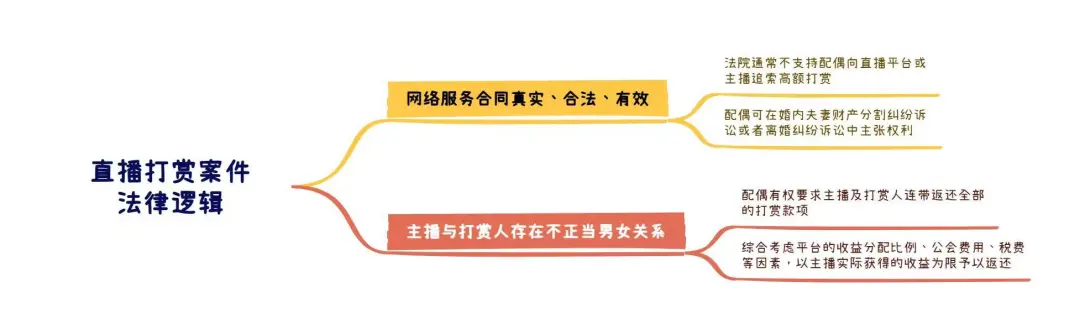
First,If the reward amount arises from a network service contract that is true, legal and valid, the court will generally not support the spouse of the reward giver in claiming the reward amount from the live streaming platform or the anchor, even if the reward amount is huge, obviously exceeds the normal family expenditure of the reward giver, and infringes on the legitimate property rights of the reward giver’s spouse.
The spouse of the reward giver may, in the dispute over the division of marital property or the divorce dispute, claim that the reward giver return the share of the spouse in the reward amount, and may also claim that the reward giver should get less or no share of the joint marital property during the divorce on the grounds that the reward giver has dissipated the joint property.
Previously, Article 5, Paragraph 3 of the Draft Opinions on the Interpretation of the Marriage and Family Chapter (II) explicitly stipulated: "Where one spouse engages in rewarding behavior through live streaming platforms, and there is evidence proving that the live streaming content contains obscene, pornographic or other vulgar information to induce users to reward, if the other spouse claims that the civil legal act is invalid and requests the live streaming platform to return the rewarded amount, the people's court shall support it in accordance with the law."
However, during the subsequent feedback process, all parties held that "vulgar information" is not a strict legal concept, which is difficult to accurately define in practice. There is also a risk of expanded application, which is not conducive to balancing the legitimate interests of all parties in the new form of the live streaming industry. Therefore, after fully considering the needs of judicial practice and absorbing these opinions, the officially promulgated Interpretation of the Marriage and Family Chapter (II) deleted this clause.
This means that if a spouse intends to claim the return of rewards by citing "illegal live streaming content", they must prove that the live streaming content contains legally prohibited content such as obscenity and pornography. Only when such reward behavior is deemed invalid due to violating mandatory legal provisions or public order and good customs can the anchor and the platform be required to fully return the reward money.
However, in reality, most live streaming platforms have obtained the Internet content service license and operate in accordance with regulatory requirements. If a spouse only claims that the live streaming content is "edge-ball" or "soft pornography" without sufficient evidence to prove it is legally prohibited, it will be difficult for the court to support the claim for returning the reward money in judicial practice.
If the spouse claims that the other party has arbitrarily disposed of a large amount of joint marital property and infringed upon the ownership of the joint marital property, the court will usually examine two aspects: first, whether the reward behavior is necessary for daily life and within the scope of the right to dispose of joint property. The court mainly examines the amount of the reward (including the single amount and the total amount), as well as factors such as the frequency, purpose, time, and duration of the reward to specifically judge whether it is for the needs of the family's daily life in each case. If the reward behavior can be identified as necessary for daily life, it does not exceed the scope of the right to dispose of joint property by one party of the couple, and the reward behavior is deemed as the joint intention of both parties, which is binding on both parties, and both parties to the marriage shall bear the legal consequences arising therefrom.
Second, the court will also examine whether the platform and the anchor have obtained the reward in good faith if the live streaming reward exceeds the scope of the marital agency power. Since the anchor and the platform cannot know the real identity, marital status and property situation of the reward giver through the Internet, they can usually claim the good faith acquisition of the reward income if there is no improper relationship or damage to others' marriage, and the court generally does not support the claim for returning the money.
Therefore, if one spouse claims that the amount of live streaming rewards is obviously beyond the family's general consumption level and seriously damages the interests of the joint marital property, in accordance with Article 6 of the Interpretation of the Marriage and Family Chapter (II), the court generally holds that this belongs to the internal handling scope of the couple. The joint marital property can be divided during the marital relationship, or the party who made the reward can be requested to get less or no share when dividing the joint marital property upon divorce, but it is impossible to require the anchor and the platform to return the money.



