


01 Basic facts of the case
Sun Moujia and Yang Mou were registered and married on July 14, 2005. Sun Mouyi was born on June 15, 2006. Sun Moujia was identified in June 2023 and found that Sun Mouyi had no blood relationship with him. He died by hanging on July 22,2023. Sun did not make a will before his death. When Sun died, his parents were alive. A residence in Yishui County ( hereinafter referred to as " the house involved in the case " ) is registered under the name of Sun Moujia and Yang Mou. It was obtained by Sun Moujia in August 2013 by replacing his premarital personal house and making up the difference of more than 30,000 yuan.
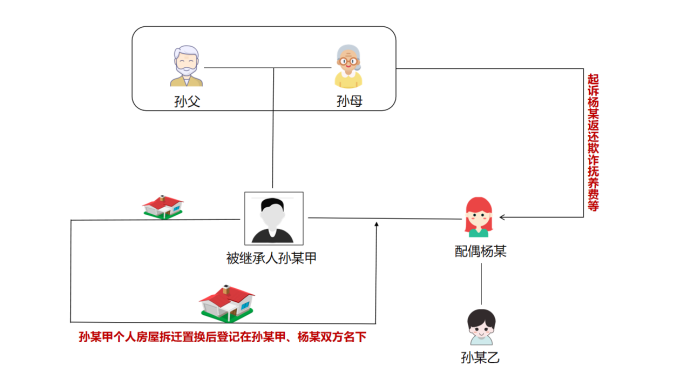
Sun 's parents sued the court, the main demands are : 1.Sun and Yang 's houses are owned by the plaintiff ; 2.Yang is suspected of fraudulent upbringing, Yang should be compensated for the upbringing of Sun Mouyi for 17 years, a total of 204000 yuan ; 3.Yang 's compensation for the plaintiff 's mental damage compensation of 60,000 yuan.
02 Court decision
1.For the distribution of housing involved in the case.
The court held that the house involved in the case was from the demolition and resettlement of the original property purchased by Mr.Sun before marriage. The compensation includes not only the value of the original property, but also the relocation reward, overdue transition fee, decoration fee and the excess part of the compensation for the difference and value-added during the resettlement. The above part should belong to the joint property of Mr.Sun and Yang Mou. As for the original property purchased by Sun Moujia before marriage, Yang is registered as the co-owner of the house involved in the replacement after marriage, which is the gift behavior implemented by Sun Moujia to maintain and enhance the relationship between husband and wife, but it does not mean that half of the original property is given to Yang.Therefore, when the situation changes, it is necessary to divide the house involved in the case. Based on the fact of the original property purchase, combined with the factors such as the duration of the marriage relationship and the reasons for the division of the property, the share that each party should enjoy should be determined as appropriate, rather than equally divided. In this case, according to the specific circumstances of the case, the house involved in the case was divided into 60 % by the two plaintiffs and 40 % by the defendant Yang.After identification, it was excluded that Sun Moujia was the biological father of Sun Mouyi, and Sun Mouyi had no inheritance right to Sun Moujia 's property.
2.Whether the plaintiff has the right to ask the defendant Yang to return the alimony of the fraudulent upbringing.
The court believes that the two plaintiffs have the right to ask Yang to return all the fraudulent maintenance fees that should be obtained by Sun Moujia. The reasons are as follows : 1. After judicial identification, Sun Moujia is excluded from Sun Mouyi 's biological father. Sun Moujia has the right to ask Yang to return the maintenance fees that he bears for Sun Mouyi. From the perspective of the nature of the right to maintenance fees, it should be a property right. After the death of Sun Moujia, the property right can be inherited by the two plaintiffs ; yang belongs to the fault party during the existence of the relationship between husband and wife, whose behavior is contrary to the good customs, and the fault party should not be the beneficiary of the property rights and interests arising from its fault. Therefore, the above-mentioned fraudulent maintenance should be inherited by the two plaintiffs. From the birth of Sun Mouyi on June 15,2006 to the death of Sun Moujia on July 22,2023, Yang should pay the amount of fraudulent maintenance of 150,635.8 yuan.
3.Whether the plaintiff has the right to ask Yang for compensation for mental damage.
The court believes that the right to claim compensation for mental damage is an indivisible and closely related right to the person of a natural person. It is an extension of the personal rights of natural persons. Without the person of a natural person, the right to claim compensation for mental damage is impossible to talk about. The personal rights of natural persons should be exercised by natural persons themselves, and there is no effective legal instruments that have transformed the right to claim compensation for mental damage enjoyed by Sun Moujia into property rights before his death. Therefore, the two plaintiffs ' claim for compensation for mental damage by Yang Mou is not supported in this case.
Therefore, the court ruled that the house involved in the case was owned by the two plaintiffs. The two plaintiffs paid a discount of 201,480 yuan ( 503,700 × 40 % ) to Yang, and Yang paid 150,635.8 yuan for fraudulent maintenance to the two plaintiffs.
03 The thinking caused by this case and the lawyer 's perspective
This case is a legal inheritance dispute, which should focus on the following controversial issues :
Thinking 1 : Regarding the scope of heirs, should Sun Moujia be deprived of Yang 's inheritance right if he committed suicide due to Yang 's serious fault ?
The answer is no. Although Yang has serious fault behavior, he does not have the legal reason to lose the right of inheritance, and still enjoys the right of inheritance of Sun 's heritage.
Article 1125 of the Civil Code clarifies the five legal reasons for the loss of the heir 's right of inheritance by enumerating, specifically for the heir to carry out any of the following acts : 1.Intentional killing of the decedent ; 2. Killing other heirs in order to compete for inheritance ; 3.Abandonment of the decedent, or abuse of the decedent serious circumstances ; 4. forging, tampering, concealing or destroying a will, if the circumstances are serious ; 5.To force or hinder the decedent to establish, change or withdraw the will by means of fraud or coercion, the circumstances are serious. In this case, although Yang 's fault led to the death of Sun 's Jia, Yang did not have the subjective intention to kill Sun 's Jia, nor did he carry out the objective act of killing Sun 's Jia. The death of Sun 's Jia was caused by his suicide. Yang did not have the legal reason to lose the inheritance right, so Yang still enjoyed the inheritance right of Sun 's Jia. Therefore, Sun 's heirs are his parents and Yang.
Thinking 2 : As for the scope of heritage, in addition to the legal property left by Sun when he died, it is still necessary to consider the legal property rights enjoyed by him, specifically :
1.Does Sun 's parents have the right to revoke part of Sun 's gift to Yang 's original property ? If it supports the revocation, how should the share of the estate belonging to Sun in the house involved be determined ?
The answer is yes. The parents of Sun Moujia certainly have the right to revoke the share of the original property that Sun Moujia gave to Yang. First of all, the first paragraph of Article 663 of the Civil Code stipulates the legal revocation right of the donor, that is, the movable property of the gift is delivered and the real estate is transferred and registered. After the performance of the gift contract, the donor can revoke the gift because the recipient has one of the following three situations : seriously infringing the legitimate rights and interests of the donor or the close relatives of the donor ; have the obligation to support the donor and do not perform ; do not fulfill the obligations stipulated in the gift contract. In this case, Yang had an improper relationship with others during the period of marriage with Sun Moujia and gave birth to Sun Mouyi.When Sun Moujia mistakenly believed that Sun Mouyi was his biological child and raised, he should have the obligation to truthfully disclose and clarify to Sun Moujia.Yang did not truthfully disclose and clarify to Sun Moujia that Sun Mouyi was not his biological child, which constituted a fraud against Sun Moujia and led to Sun Moujia raising Sun Mouyi for up to 17 years without raising Sun Mouyi, which seriously infringed Sun Moujia 's legal property rights. Therefore, Sun Moujia certainly enjoys the legal right of revocation.
Secondly, Article 664 of the ' Civil Code ' stipulates that if the donor dies or loses his civil capacity due to the illegal act of the donee, the heir or legal agent of the donor may revoke the donation. The right of revocation of the heir or legal representative of the donor shall be exercised within six months from the date when he knows or should have known the cause of revocation. In this case, due to Yang 's illegal behavior, Sun Moujia died. After the death of Sun Moujia, his legal right to revoke Yang Moujia should be exercised by Sun Moujia 's parents within six months from the date when they knew or should have known the cause of revocation.
Finally, after Sun Moujia 's parents revoked Sun Moujia 's part of the share of the original property gifted to Yang, the value of the house involved in the case is still greater than the value of the original property, still belonging to Sun Moujia and Yang. The couple 's joint property. Article 1153, paragraph 1, of the Civil Code stipulates that, when dividing the property jointly owned by husband and wife, half of the jointly owned property shall be divided into the property of the spouse and the rest into the estate of the decedent, unless agreed upon. In this case, Sun Moujia and Yang Mou did not sign a written property agreement to dispose of the house involved in the case. Therefore, no matter how much the capital contribution or contribution to the house involved in the case is revoked, it is still impossible to change the fact that the house involved in the case belongs to the joint property of Sun Moujia and Yang Mou. Therefore, when dividing the heritage, half of the houses involved in the case should be divided into Yang 's personal property, and the remaining half belongs to Sun 's heritage. The original judge divides the estate by divorce and separation of property, and the error of the applicable situation should be corrected. Divorce and inheritance are two different legal relations, and the rules for handling divorce disputes cannot be applied to inheritance disputes. The opposite party of the legal relationship in the divorce dispute is the husband and wife, and the husband and wife take the initiative to terminate the marriage relationship. In order to solve the disputes between the husband and wife in the marriage and balance the interests between the two parties, the principle of unequal division of the common property of the husband and wife can be considered on the basis of common ownership, such as the protection of rights and interests, the punishment of faults, and the care of the weak. It can claim the preferential division of common property, economic assistance, compensation, compensation, and does not involve the interests of third parties.The relative person of the legal relationship in the inheritance dispute is the heir. It is for each heir to solve the inheritance dispute and the distribution of the inheritance. It focuses on protecting the equal inheritance rights of male and female heirs, subrogation heirs, and widowed daughters-in-law and widowed son-in-law who have fulfilled their main maintenance and support obligations. When dividing the heritage, the principle of equal division is adopted. At the same time, it takes into account that those who need the heritage in particular and those who have more obligations to the decedent can be divided more. It not only prevents absolute egalitarianism, but also reflects real fair protection, without involving the protection of rights and interests between the decedent and his or her spouse, fault punishment, and care for vulnerable parties. Therefore, according to the relevant legal provisions of inheritance disputes, there is and only one standard when separating the estate of the decedent from the joint property of the husband and wife, that is, to examine whether the husband and wife have entered into a legally valid written property agreement. If there is an agreement, it shall be handled in accordance with the agreement. If there is no agreement or the agreement is invalid, half of the joint property of the husband and wife shall be divided into the property of the spouse, and the remaining half shall be the estate of the decedent. However, if after Sun 's parents revoked the gift, the value of the original property is equal to or greater than the value of the house involved in the case, that is, the house involved in the case is the transformation of Sun 's personal house before marriage, the house involved in the case does not need to be divided into half as Yang 's personal property, and all of its shares belong to Sun 's heritage.
2.Does Sun 's parents have the right to request Yang to return fraudulent maintenance ? If the return is supported, how to determine the share of the inheritance belonging to Sun in the maintenance fee and how to allocate it ?
The current law does not stipulate whether Sun 's parents have the right to ask Yang to return fraudulent maintenance. In the reply of the Supreme People 's Court on whether the husband can recover the maintenance fee from the woman after the divorce of the non-biological children who were defrauded by the husband during the existence of the husband-wife relationship ( hereinafter referred to as the reply ), the Supreme People 's Court held that : ' During the existence of the husband-wife relationship, one party has had children through adultery with others, concealing the truth, and the other party has been defrauded to raise non-biological children, in which the maintenance fee paid after the divorce, if the defrauded party requests it, can be returned as appropriate ; as for whether the maintenance expenses of the cheated expenses should be returned during the existence of the relationship between husband and wife, because the problems involved are more complicated, further research is needed. As far as the specific cases mentioned in your court are concerned, because the common property of the two parties has been divided by the man alone at the time of divorce, it can not be returned. The above opinions are for reference. '
The ' reply ' made it clear that the alimony paid after divorce should be returned, and whether the alimony paid during the marriage relationship should be returned has not been stipulated. In this case, the alimony paid by Sun Moujia occurred during the existence of his marriage relationship with Yang Mou.Although there is no clear legal basis, it can be handled with reference to the relevant provisions applicable to unjust enrichment. Unjust enrichment refers to the situation of obtaining improper benefits without legal basis and causing losses to others. In social life, any civil subject must not have no legal basis to obtain benefits and cause damage to others. Therefore, the law stipulates that the person who has suffered losses has the right to request the person who has obtained unjust enrichment to return the improper benefits. In this case, Sun Moujia did not have a statutory obligation to support Sun Mouyi.Sun Moujia 's support of Sun Mouyi was not his true intention, but was caused by Yang 's fraud. Yang and other extramarital heterosexuals jointly gave birth to Sun Mouyi, and should bear the obligation of raising Sun Mouyi.However, because Sun Moujia raised Sun Mouyi without knowing it, he obtained improper benefits, resulting in the loss of Sun Moujia 's property, which should be returned to Sun Moujia. In view of the fact that Sun Moujia has died, his parents generally bear his legal rights and obligations, and of course have the right to require the unjust enrichment of Yang Mou and other heterosexuals ( should be disclosed by Yang Mou, otherwise Yang Mou will bear all and recover part of the share from the heterosexual ) to jointly return the fraudulent maintenance fee.At the same time, Sun Moujia 's raising of Sun Mouyi occurred during the existence of his marriage relationship with Yang Mou, and his maintenance fee came from the joint property of the husband and wife of both parties. Therefore, Yang Mou and other fraudulent maintenance fees after the return of the opposite sex still belong to the joint property of Yang Mou and Sun Moujia.According to the principle of separating inheritance from the joint property of husband and wife, half of it should be taken as Yang Mou 's personal property, and the remaining half belongs to Sun Moujia 's inheritance. The court of the original trial obtained all the maintenance judgments after the return from Sun 's parents. In fact, it deprived Yang 's inheritance share, which is different from the scale of inheritance and division of the houses involved in the case, and remains to be discussed.
3.Does Sun 's parents have the right to claim Yang 's payment of Sun 's mental damage ?
Sun 's parents have no right to claim Yang to pay Sun 's mental damage solatium. Although Yang 's marital infidelity and fraud in Sun 's raising Sun 's B not only caused property damage to Sun 's A, but also inevitably caused serious infringement of Sun 's personal rights and interests, according to the first paragraph of article 1183 of the ' Civil Code ', if the infringement of the personal rights and interests of natural persons causes serious mental damage, the infringer has the right to request compensation for mental damage. It can be seen that mental damage compensation has personal attributes, and is exclusive to the infringer and cannot be exercised as a property right by the heir. However, if Sun and Yang have reached an agreement on compensation for mental damage or the support of effective judgment documents before his death, the rights and interests have been transformed into property rights and can be claimed by the heirs.
So does Sun 's parents have the right to ask Yang to pay their two people 's mental damage solatium ? In judicial practice, the close relatives of the infringed have the right to claim compensation for mental damage to the infringer. It is common in serious accidents such as traffic accidents, medical accidents, intentional injury or intentional homicide that cause death. It requires the infringer to commit an act that infringes on the right to life of the deceased, causing serious mental damage to the close relatives of the deceased. There is a causal relationship between the infringement and the death of the deceased, and the infringer has a subjective fault. In this case, although Yang 's infidelity and fraudulent upbringing caused damage to Sun 's property and spirit, it did not infringe Sun 's right to life. The act that led to Sun 's death was his suicide, which had no causal relationship with Yang 's infidelity and fraudulent upbringing. Therefore, Sun 's parents also have no right to claim mental damages to Yang.
Thinking 3: On the handling of the heritage, if Yang enjoys the right of inheritance, in view of Sun 's suicide due to Yang 's serious fault behavior, should Yang 's share of inheritance be reduced ?
The answer is no. Article 1130 of the Civil Code stipulates the principle of equal inheritance and distribution of inheritance by heirs in the same order. Of course, heirs who have done their main support obligations to the decedent or live together with the decedent can be divided more when distributing the inheritance. The heirs who have the ability to support and the conditions to support, who do not fulfill the obligation to support, should be divided or less when distributing the inheritance. As mentioned above, half of the houses involved in the case belong to Yang 's personal property, and the remaining half belong to Sun 's heritage. If Sun 's parents do not have the main maintenance obligation to them, or Yang does not have the main maintenance obligation to Sun 's, then the half share of the estate belonging to Sun 's in the house involved in the case belongs to Sun 's. Sun 's parents and Yang as the first order heirs of Sun 's should be dealt with according to the principle of equal inheritance. After inheritance, Yang occupies 4 / 6 ( 1 / 2 + 1 / 2 × 1 / 3 ), and Sun 's parents each occupy 1 / 6 share. Sun 's parents obtained the house involved in the case and paid Yang a 4 / 6 share of the compensation for the house price involved in the case. As for the return of fraudulent maintenance fees, half of the share of Sun 's inheritance should also be divided by Sun 's parents and Yang 's three people.
Although the occurrence of the above results is inconsistent with the situation, it is mainly because Sun Moujia neglects to exercise his legal rights, fails to investigate Yang Mou 's marriage fault, and fails to make a legal and effective will to deprive Yang Mou 's inheritance rights, which in turn causes the unfavorable situation of the relatives ' hatred. The original trial court did not determine the scope of the heirs, the scope of the estate and the share of the heirs in accordance with the normal thinking of the judgment, and the judgment was also the result of a comprehensive balance of human feelings and legal principles.