


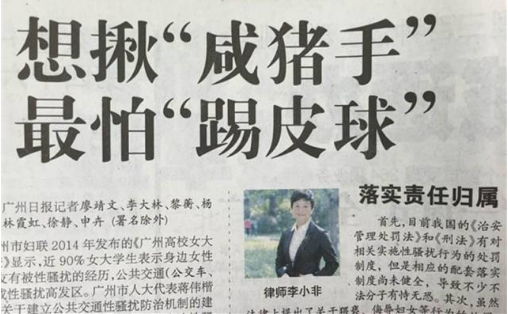
Recently, Jiang Weikai, a deputy to the Guangzhou Municipal People's Congress, submitted the Suggestions on Establishing a Prevention and Control Mechanism for Sexual Harassment in Public Transportation at the Guangzhou Two Sessions in response to the frequent occurrence of sexual harassment in the public transportation system. Attorney Li Xiaofei accepted an interview with Guangzhou Daily regarding the phenomenon of sexual harassment in public places.
The Survey on Female College Students in Guangzhou Universities released by the Guangzhou Women's Federation in 2014 showed that nearly 90% of female college students stated that their female classmates and friends around them had experienced sexual harassment, and public transportation (such as buses and subways) had become a high-incidence area for sexual harassment. Jiang Weikai, a deputy to the Guangzhou Municipal People's Congress, submitted theSuggestions on Establishing a Prevention and Control Mechanism for Sexual Harassment in Public Transportation, proposing that a working system for the prevention and control of sexual harassment in public transportation be incorporated into local regulations and that the "first-responsibility system" for handling sexual harassment be implemented .
Attorney Li Xiaofei said: Implementing Responsibility Attribution
First of all, at present, China's Public Security Administration Punishment Law and Criminal Law have penalty systems for relevant sexual harassment acts, but the corresponding supporting implementation systems are not yet improved, leading many lawbreakers to act with impunity . Secondly, although the law provides for penalties for acts such as molestation and insult of women, the ambiguity of the legal liability attribution clauses has become a major difficulty in implementing specific responsibilities . In addition, when an infringement occurs, the subject of liability attribution is unclear, and accountability faces the problem of "passing the buck". Furthermore, the definition of relevant terms is vague, and when encountering specific cases, there is no basis to determine whether they should be classified under the relevant clauses.