The Anti-Domestic Violence Law of the People’s Republic of China came into force on March 1, 2016.
Article 2 of the Law clearly defines domestic violence as infringements upon physical and mental rights committed between family members by means of beating, binding, maiming, deprivation of personal liberty, as well as habitual abuse and intimidation.
Meanwhile, Article 37 stipulates that:
Acts of violence committed between persons living together who are not family members shall be governed by reference to the provisions of this Law.
It is not difficult to see that the disposal measures and protective provisions under the
Anti-Domestic Violence Law differ essentially depending on whether the parties involved qualify as "family members".
Accordingly, the accurate interpretation of the scope of "family members" constitutes a crucial prerequisite for the application of this Law in judicial practice.
For instance, in the case of stepparent-stepchild relationships, where lies the applicable boundary of the Anti-Domestic Violence Law?
Upon sorting out relevant provisions, it is found that many provinces and autonomous regions across the country have issued supporting regulations for the implementation of the Anti-Domestic Violence Law. Nevertheless, only a few regions have clearly specified whether stepparents and stepchildren fall within the scope of family members.
The detailed provisions are listed in the table below:
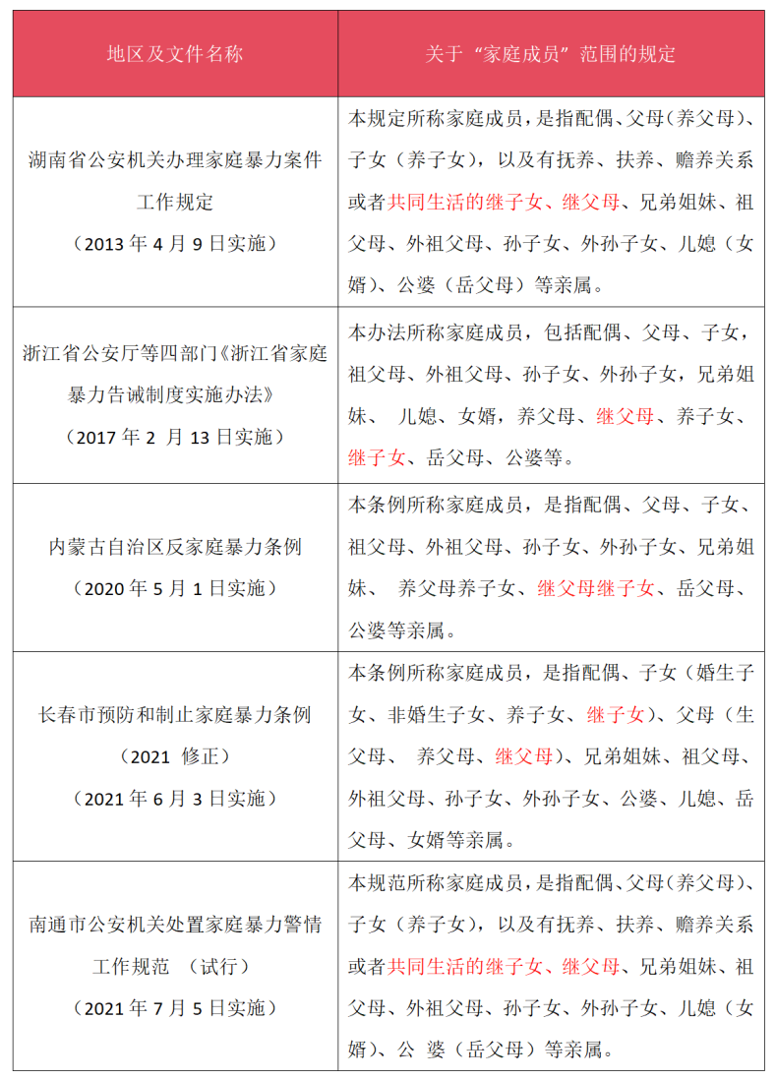
From the perspective of superior legal basis, Article 1045 of the Civil Code defines family members as follows:
Spouses, parents, children, siblings, paternal grandparents, maternal grandparents, grandchildren and maternal grandchildren are close relatives. Spouses, parents, children and other close relatives living together constitute family members.
Meanwhile, Article 1127 of the Civil Code further clarifies that:
Children include legitimate children, illegitimate children, adopted children and stepchildren who have a maintenance relationship; parents include natural parents, adoptive parents and stepparents who have a maintenance relationship.
It is worth noting that there exists a regulatory gap in the aforementioned provisions of the Civil Code. From the perspective of legal fiction, it remains complicated to directly determine whether stepchildren are naturally included in the scope of "children", and whether stepparents naturally fall into the category of "parents", so as to be recognized as family members.
This discrepancy has led to inconsistent definitions of stepparents and stepchildren in supporting regulations issued by different regions. For instance, both the Measures of Public Security Organs of Hunan Province for Handling Domestic Violence Cases and the Working Norms of Public Security Organs of Nantong City for Disposing Domestic Violence Police Calls (Trial) stipulate that cohabitation is a prerequisite for stepparents and stepchildren to be classified as family members.
From the perspective of stepfamilies, it is evident that many stepparents and stepchildren do not necessarily live together.Against this background, can stepparents and stepchildren who suffer from domestic violence receive protection under China’s Anti-Domestic Violence Law?
Let us first look at a case:
Case Background
In 2009, the father of the applicant Wang Mou (Wang Mou 3) and his mother Tian Mou divorced by agreement. At that time, the applicant Wang Mou and her younger sister Wang Mou 4 had already reached the age of majority.
Later, Wang Mou 3 remarried the respondent Wang Mou 2. No maintenance relationship was formed between the two sisters and Wang Mou 2, nor did they live together.
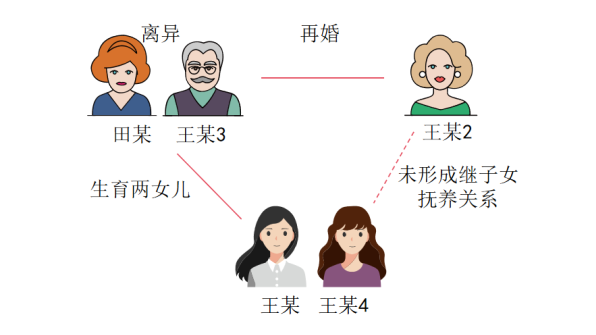
Since 2014, Wang Mou 2 has repeatedly committed tortious acts against Wang Mou, her sister and their family members: in the Spring Festival of 2014, she insulted Wang Mou and her mother, which led to a police report; in December 2024, she went to their home twice to insult them, smash their door, and even pinched Wang Mou’s brother-in-law; in May 2025, when she smashed the door and insulted them, she grabbed Wang Mou’s spouse by the neck and pushed them to the ground, causing minor injuries; in June 2025, she pried open the door and smashed the doors and items of Wang Mou and her sister’s homes, and was jointly detained by the public security organs for 14 days; the day after her detention expired, she went to the downstairs of Wang Mou’s residence and insulted her for half an hour.
Wang Mou suffered from severe depression due to long-term harassment, so she applied for a personal safety protection order in accordance with the Anti-Domestic Violence Law, putting forward three requests:
- Prohibit the respondent from harassing, intimidating, threatening or assaulting the applicant and the applicant’s family members (including but not limited to Li Mou, Wang Mou 4 and Du Mou);
- Prohibit the respondent from entering the applicant’s residence (Room ×, Unit ×, Building ×, District ×, Beijing) and the area within 100 meters of this residence;
- Prohibit the respondent from contacting or harassing the applicant and her family members by means of telephone, short message, WeChat, e-mail and other methods.
Upon examination, the people’s court holds that the issuance of a personal safety protection order shall meet the following conditions:
- There is a definite respondent;
- There are specific claims;
- The applicant has suffered domestic violence or faces imminent danger of domestic violence.
A personal safety protection order may include the following measures:
- Prohibiting the respondent from committing domestic violence;
- Prohibiting the respondent from harassing, stalking or contacting the applicant and the applicant’s close relatives;
- Ordering the respondent to move out of the applicant’s residence;
- Other measures for protecting the personal safety of the applicant
In this case, Wang Mou 2 admitted that she had smashed the door of the applicant’s residence and insulted Wang Mou. In addition, evidenced by the administrative penalty decision, police case acceptance receipt and other materials submitted by Wang Mou, Wang Mou 2’s conducts have indeed endangered the personal safety, life and health of Wang Mou and her family, posing an imminent risk of harm.
Therefore, the Court holds that the applicant’s request to prohibit Wang Mou 2 from harassing, intimidating, threatening or assaulting the applicant and her close relatives, as well as prohibiting the respondent from approaching the applicant’s residence, complies with the statutory conditions for issuing a personal safety protection order and shall be granted. The remaining claims of the applicant are hereby dismissed.
- The respondent Wang Mou 2 is prohibited from harassing, stalking or contacting Wang Mou and her relevant close relatives;
- The respondent Wang Mou 2 is prohibited from entering Wang Mou’s residence, namely, House ×, Unit ×, Building ×, × District, Beijing;
- The rest of Wang Mou’s applications are dismissed.
This ruling shall remain valid for six months from the date of issuance. Before the expiration of the personal safety protection order, the people’s court may revoke, modify or extend it upon the applicant’s application.
The core dispute in this case lies in whether a stepchild who has no maintenance relationship and does not cohabit with their stepparent can be recognized as a "family member" within the meaning of the Anti-Domestic Violence Law.
In light of the court’s reasoning, Haidian District People’s Court did not take "cohabitation" or "formation of a maintenance relationship" as a prerequisite for identifying a family member. Instead, it focused on whether the respondent’s conduct constituted domestic violence and posed an actual imminent danger.
Despite the lack of financial ties and emotional bonds between Wang Mou and her stepmother Wang Mou 2, the court still issued a personal safety protection order in accordance with the law. This reflects a tendency toward a lenient interpretation of the scope of "family members".
With social development, diverse family structures featuring divorce and remarriage have become increasingly prevalent. Clarifying the definition of "family members" is essential to the practical application of the
Anti-Domestic Violence Law of the People’s Republic of China.
Relationships within remarried families are inherently complex. The author holds that, from the perspective of the Anti-Domestic Violence Law, cohabitation or the establishment of a support relationship shall not be taken as rigid criteria to determine whether stepparents and stepchildren qualify as family members.
The legislative intent of the Anti-Domestic Violence Law is to prevent and curb domestic violence and protect the legitimate rights and interests of family members. It is recommended that legislators clarify the defining criteria for family members from the anti-domestic violence perspective, so as to eliminate regional disparities and ambiguities in law application. Only in this way can the law serve as a reliable safeguard for all potential victims of domestic violence, and effectively uphold family harmony and social stability.



