


The mother’s only residential property was purchased by her younger son, who immediately transferred out the proceeds of RMB 2.2 million to repay his personal debts. The elder son initiated proceedings in the mother’s name to claim the sale proceeds back from the younger son, yet the court of first instance dismissed the action on the ground that joint guardians must sue together. In judicial practice, where joint guardians hold conflicting views, may some guardians sue separately to protect the ward’s interests? We examine this real case below.
I. Case Background
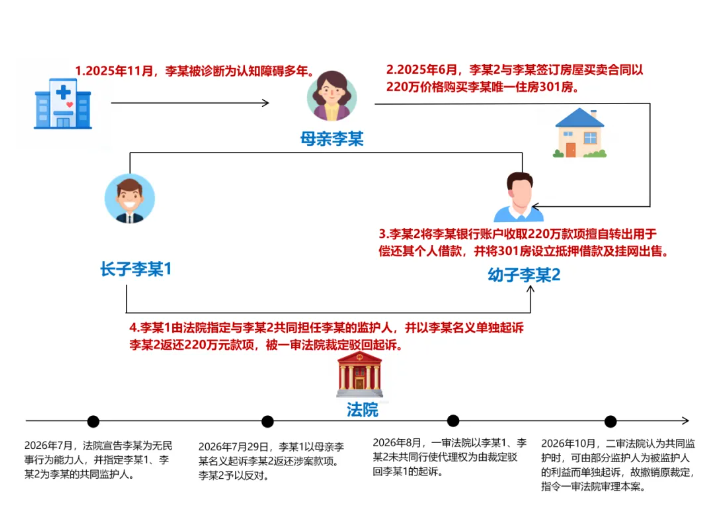
Li, born in 1938, outlived her spouse and parents. She had two sons, Li 1 and Li 2.
In November 2025, Li was diagnosed with cognitive impairment of many years’ standing.
In June 2025, Li entered into a property sales contract with her younger son Li 2, agreeing to sell her only home, Unit 301, to Li 2 for RMB 2.2 million. Title to Unit 301 was subsequently transferred to Li 2.
In July 2025, Li 2 transferred the RMB 2.2 million sale proceeds into Li’s bank account. He then took advantage of his custody of the account and password to withdraw the full amount and use it to settle his personal loans. Li 2 mortgaged Unit 301 with a bank and listed it for resale online.
In July 2026, the people’s court adjudged Li a person without civil capacity and appointed Li 1 and Li 2 as her joint guardians.
On 29 July 2026, Li 1 sued Li 2 in Li’s name for the return of the disputed funds. Li 2 objected to Li 1 bringing the action alone on Li’s behalf.
In August 2026, the court of first instance dismissed Li 1’s application on the basis that Li 1 and Li 2 had not exercised their power of agency jointly.
In October 2026, the court of second instance held that in a joint guardianship arrangement, some guardians may sue separately for the ward’s benefit. It therefore set aside the original ruling and remitted the case to the court of first instance for trial on the merits.
II. Lawyer’s Analysis
The core issue in this case is whether some guardians may institute proceedings in the ward’s name where joint guardians disagree. No express provision governing this scenario exists under current laws and regulations. Nevertheless, the author submits that such actions should be permitted for the following reasons:
First, current laws do not impose a joint agency rule for the exercise of authority by statutory agents. Article 163 of the Civil Code distinguishes between entrusted agency and statutory agency: entrusted agents act under the principal’s authorisation, while statutory agents act pursuant to provisions of law. Article 166 of the Civil Code, which governs “joint agency”, appears in Section 2 of Chapter VII on “Entrusted Agency”. It regulates situations where several entrusted agents exercise agency jointly for the same entrusted matter, a regime rooted in the principal’s voluntary intent. A statutory agent’s authority derives from law rather than the ward’s volition. The manner in which statutory agents exercise their powers is not explicitly prescribed by legislation.
Second, the rules for entrusted agency, including joint agency, cannot be applied by analogy to statutory agency. Guardianship authority is not merely a right but a duty, and its exercise must comply with the principle of acting in the ward’s best interests. Article 35 of the Civil Code provides that guardians shall perform their duties in the ward’s best interests and may not dispose of the ward’s property except for the ward’s benefit. Article 168 of the Civil Code prohibits self-dealing and dual agency, reflecting the fundamental principle that no person may be both player and judge in their own cause. The law sets a minimum moral standard and ought not to demand the impossible. In this case, Li 2, one of Li’s guardians, had misappropriated Li’s assets and infringed her rights; he was the defendant with a direct adverse interest. He would never consent to Li 1 suing him on Li’s behalf. The first-instance requirement that Li 1 and Li 2 sue Li 2 jointly in Li’s name lacks legal basis, defies common sense, and effectively closes off Li’s avenue of redress. Accordingly, statutory agency should allow some guardians to sue separately to protect the ward, rather than importing the joint-suit rule applicable to entrusted agency by analogy.
Third, a procedural distinction must be drawn: whether a statutory agent may exercise agency goes to the scope of authority, while whether a claim satisfies the threshold for filing is assessed against the requirements in Article 122 of the Civil Procedure Law. The first-instance court used the former to reject the latter via a dismissal order, turning an issue that could have been clarified or cured during litigation into a final bar to substantive adjudication. The reversal by the appellate court returns the dispute to the merits track.
III. Practitioner Recommendations
This scenario is not isolated in practice. Multiple courts in Guangzhou have dismissed separate claims brought by some statutory guardians on the ground of failure to act jointly. This outcome stems partly from judges applying entrusted agency rules by analogy and misinterpreting joint agency in the absence of clear statutory text. The root cause, however, is the deadlock that arises when multiple court-appointed guardians cannot reach consensus.
Article 9 of the Judicial Interpretation of the Supreme People’s Court on Several Issues Concerning the Application of the General Provisions of the Civil Code provides that courts appoint guardians in the ward’s best interests. As a general rule, a single guardian shall be appointed; multiple guardians may be appointed only where joint guardianship better protects the ward. The legislative intent behind multiple guardians is mutual oversight and checks and balances. In practice, however, joint guardianship can hinder the smooth exercise of guardianship powers. In this case, even though Li 1 filed evidence showing Li 2 had harmed Li’s property interests when applying for guardianship, the appointing judge still designated Li 1 and Li 2 as joint statutory guardians, on the basis that a declaration of incapacity is a special procedure that does not adjudicate substantive rights. Appointing several children as joint guardians for an elderly parent remains a common outcome.
To avoid this litigation deadlock caused by multiple guardians, we offer three recommendations:
- Plan guardianship while still having full capacity. Article 33 of the Civil Code permits adults with full civil capacity to appoint, in writing, their future guardian(s) in advance. Where multiple guardians are named, an order of priority should be set to prevent decision deadlock. A valid advance guardianship agreement reduces disputes over who shall serve as guardian and largely avoids the stalemates common in joint guardianship.
- Include oversight mechanisms in the advance guardianship agreement. Once the principal loses capacity and cognition, they cannot supervise a guardian who neglects or abuses their duties. A pre-appointed supervisor may regularly review guardianship matters, receive guardianship reports, rectify inadequate performance, and, where necessary, apply to the court for removal of guardianship and the appointment of a substitute guardian.
- Preserve evidence early. Deterioration of civil capacity is usually gradual. Medical records, consultation notes, daily video footage, care arrangements, bank statements and chat logs should be preserved promptly. Where appropriate, an assessment of civil capacity may be commissioned in advance. Once the capacity finding is confirmed, an application may be filed for a declaration that the principal lacks or has limited civil capacity, enabling the court to appoint guardians at an early stage.