


Foreword
Attorney Li Xiaofei has specialized in the field of marriage and family law for sixteen years. For many years, she has led a team of marriage and family lawyers in South China, dedicating themselves to research and judicial practice in the field of marriage and family legal services. Addressing the pressing issue of child custody in current marriage and family disputes, Attorney Li and his team spent several months analyzing and compiling the following big data report for reference by all sectors of society.
Big Data Analysis Report on Child Custody Issuesin Second-Instance Marriage and Family Dispute CasesHandled by the Intermediate People’s Courts of Guangzhou, Foshan, and Shenzhen
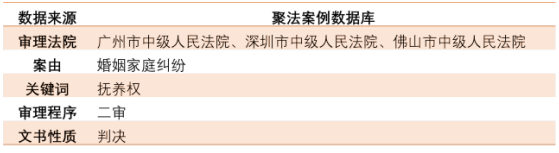
This report draws on the JuFa Case Law Database as its primary source. It screens, organizes, and analyzes a total of 926 second-instance judgments regarding child custody disputes issued between January 1, 2003, and December 21, 2016, within the jurisdictions of the Guangzhou, Shenzhen, and Foshan Intermediate People’s Courts in Guangdong Province, and presents the following analytical findings.
I. Statistical Data for the Analysis Report
About the Database
(1) Distribution of Cases
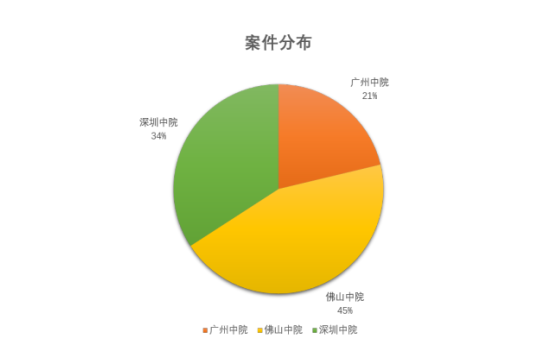
After screening, a total of 287 valid second-instance judgments were identified regarding marital and family disputes over child custody within the jurisdictions of the Intermediate People’s Courts of Guangzhou, Foshan, and Shenzhen between January 1, 2003, and December 21, 2016. Of these, 61 judgments were issued within the jurisdiction of the Guangzhou Intermediate People’s Court, 128 within the jurisdiction of the Foshan Intermediate People’s Court, and 98 within the jurisdiction of the Shenzhen Intermediate People’s Court.
In terms of case distribution, among the marital and family disputes concerning child custody in Guangzhou, Foshan, and Shenzhen, the Foshan Intermediate People’s Court handled the largest number of cases, accounting for 45%.
(2) Distribution of Child Types in the Cases
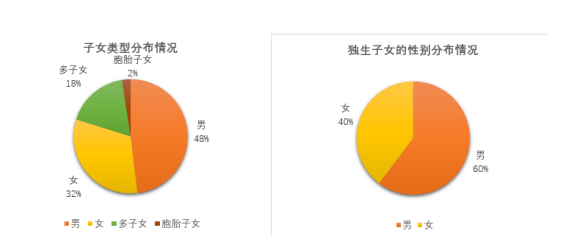
Among the 287 valid judgments, 229 (80%) involved marital and family disputes concerning the custody of an only child; There were 58 cases involving the custody of multiple children, accounting for 20%; among these, 7 cases involved the custody of twins, accounting for 2%.
Further breaking down the cases involving the custody of an only child by gender, there were 138 cases concerning the custody of an only son, accounting for 60%, and 91 cases concerning the custody of an only daughter, accounting for 40%.
The number of marital and family disputes concerning the custody of only sons was 1.5 times that of cases concerning the custody of only daughters.
(3) Age Distribution of Only Children in Cases
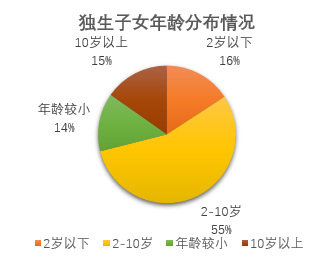
Analysis of the age distribution of children in marital and family disputes over the custody of only children reveals that such disputes occur most frequently when the children are between 2 and 10 years old, with 131 cases, accounting for 69% of the total. (Note: For statistical purposes, 26 judicial documents describing the child as “young” without disclosing a specific age were also included in the statistical scope of custody disputes involving children aged 2–10.)
(4) Procedural Matters
1. In marital and family disputes regarding child custody, more than half of the cases involved parties dissatisfied with the first-instance judgment
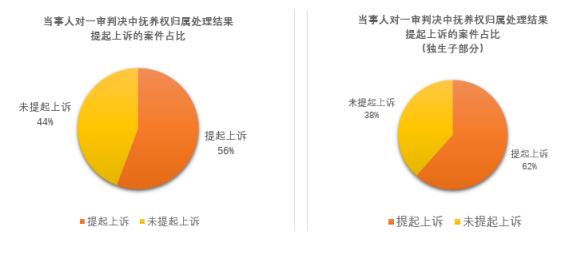
Among 287 valid judgments, 159 cases (56%) involved parties dissatisfied with the custody determination in the first-instance judgment.
In 138 marital and family disputes concerning the custody of an only son, 85 cases (62%) involved parties appealing the custody determination in the first-instance judgment;
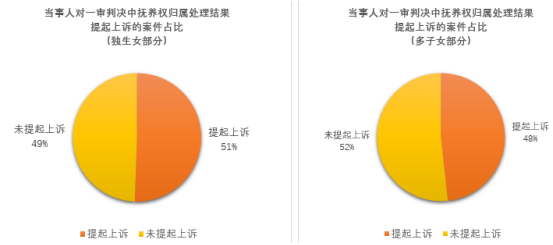
In 91 marital and family dispute cases involving the custody of an only daughter, parties appealed the first-instance ruling on custody in 46 cases, accounting for 51%;
Among 58 marital and family dispute cases involving custody of multiple children, 28 cases (48%) involved parties appealing the custody determination in the first-instance judgment.
2. Court 's Revision of the Judgment on the Ownership of Children 's Custody
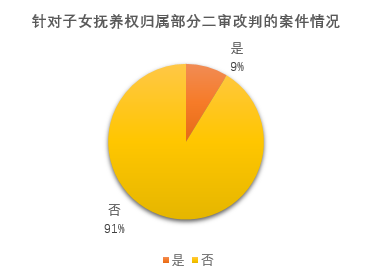
Among the 287 valid judgments, there were 13 cases in which the second-instance court reversed the first-instance ruling on child custody, accounting for 9%.
In 5 of these cases (36% of all overturned rulings), the court’s rationale was that the child had been living with the father or mother for an extended period. The remaining reasons primarily included circumstances where the father or mother was deemed unsuitable to raise the child, respect for the child’s personal wishes, and consideration of the child’s best interests.
3. Proportion of Parties Who Retained Lawyers or Legal Representatives in Second-Instance Cases Involving Reversals of Child Custody Decisions
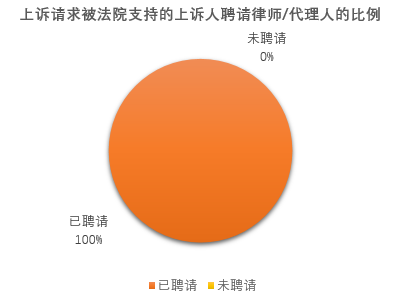
In the 13 second-instance cases where the court reversed the original decision regarding child custody, all appellants whose claims were upheld by the court had retained lawyers or legal representatives.
II. Analysis of Factors Affecting the Assignment of Custody
1. Ownership of Custody of Different Types of Children
(1) The Ownership of the OnlyChild 's Custody
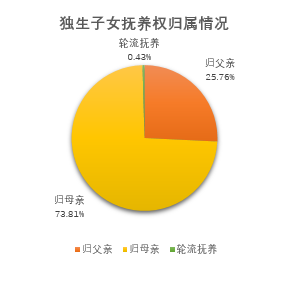
Among 229 marital and family dispute cases involving the custody of only children, custody was awarded to the mother in 169 cases, accounting for 73.81%, while custody was awarded to the father in 59 cases, accounting for 25.76%. Additionally, there was one case where custody was awarded to both parents on a rotating basis.
According to Article 6 of the “Several Specific Opinions of the Supreme People’s Court on the Handling of Child Custody Issues in Divorce Cases by People’s Courts”: “Where both parents agree to share custody of the child on a rotating basis, such an arrangement may be permitted, provided it is in the best interests of the child.” If both parents have comparable parenting capabilities and both wish to raise the child, shared custody on a rotating basis is another option available to them.
Summary: The Relationship Between a Child’s Gender and the Ownership of Custody
Among the 229 marital and family dispute cases involving the custody of an only child, there were only two instances where the child’s gender was considered as a factor in determining custody.
In Judgment (2014) Guangzhou Intermediate People's Court Civil Final Judgment No. 3253, the court explicitly cited the child’s gender as a factor in determining custody. The court stated in its judgment: “As a daughter enters adolescence, she has a greater need for guidance and education from a mother, who is also a woman.” Similarly, in Judgment (2014) Guangzhou Intermediate People's Court Civil Final Judgment No. 3052, the court also considered the child’s gender as a factor in determining custody. The court stated in the judgment: “The daughter is still very young. Given the characteristics of a female child’s future development, it would be more appropriate for the mother to care for her, in the interest of the child’s healthy growth.”
(2) Custody of Multiple Children and Twins—Having multiple children does not automatically mean they must be raised separately by both parents
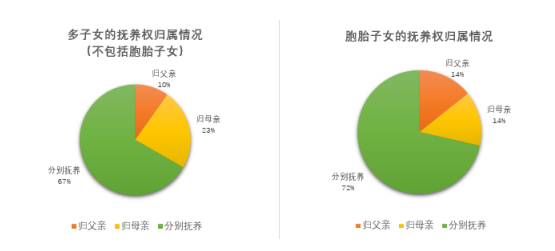
In family law disputes regarding the custody of multiple children and twins, court rulings generally favor separate custody by both parents. However, there are still cases where all multiple children or twins are awarded to one parent.
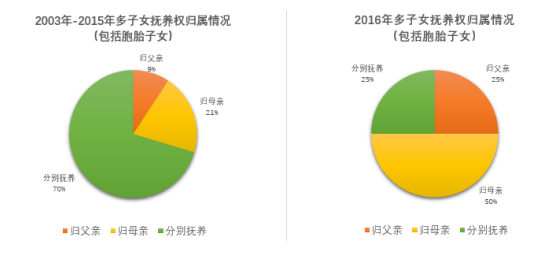
China’s Population and Family Planning Law was revised on December 27, 2015. Article 18 of the Population and Family Planning Law explicitly states, “The state advocates that a married couple have two children.” This also signifies that the country has officially entered the “two-child era.”
As shown in the two charts above, there is a clear distinction in how courts handled custody disputes involving multiple children before 2016 and after 2016. Prior to 2016, cases in which the court awarded custody of all children to one parent accounted for 30% of the total; however, after 2016—following the relaxation of the two-child policy—such cases accounted for 75% of the total, an increase of 45 percentage points compared to previous years.
2. The Ownership of the Custody of the Only Child of Different Ages
(1) Affiliation of the only child under the age of 2 - Ninety percent of the cases in which the court awarded the custody of the only child under the age of 2 to the mother
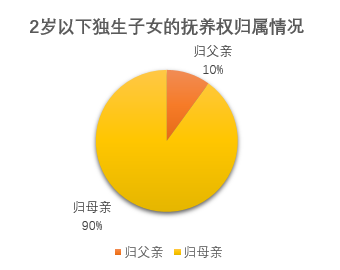
There were a total of 3 cases in which the court awarded custody of an only child under the age of 2 to the father, accounting for 10% of the total. In all these cases, the reason was that the child had been living with the father all along, and it was deemed inappropriate to disrupt the child’s living environment. In all 3 of these cases, the party awarded custody (i.e., the father) had retained legal counsel.
According to Article 1 of the “Several Specific Opinions on the Handling of Child Custody Issues in Divorce Cases by People’s Courts,” there are primarily three scenarios in which children under two years of age live with the father: Generally, children under two years of age live with the mother; however, they may live with the father if the mother falls under any of the following circumstances: (1) She suffers from an incurable infectious disease or other serious illness, making it unsuitable for the child to live with her; (2) The mother has the means to provide for the child but fails to fulfill her child-rearing obligations, and the father requests that the child live with him; (3) For other reasons, the child is indeed unable to live with the mother. Additionally, if both parents reach a mutual agreement and it does not adversely affect the child’s healthy development, a child under two years of age may also live with the father.
(2) Ownership of custody of only children aged 2-10 years - The proportion of children sentenced by the court to be raised by their fathers has increased significantly
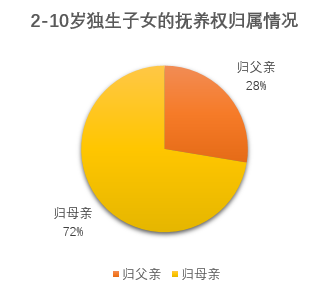
In custody disputes involving only children aged 2–10, courts awarded custody to the mother in 76 cases, accounting for 72% of the total, while custody was awarded to the father in 29 cases, accounting for 28%. Compared to court rulings on custody of children under two years of age, the proportion of cases where the court awarded custody of children aged 2–10 to the father increased by 18 percentage points.
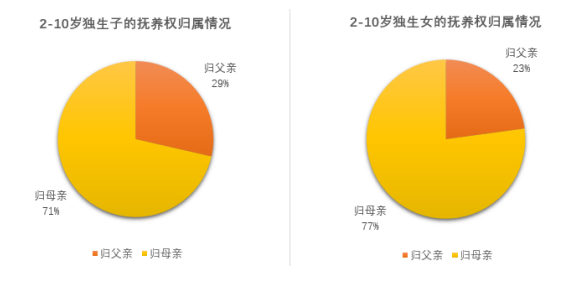
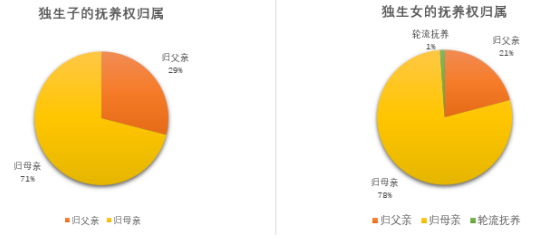
When analyzing cases involving only children aged 2–10 by gender, out of 80 custody disputes for boys in this age group, courts awarded custody to the father in 20 cases, accounting for 29%; In contrast, among the 35 custody disputes involving only daughters in the same age group, the court awarded custody to the father in 8 cases, accounting for 23%. (By gender)
By summarizing and analyzing the cases in which the court awarded the custody of the only child aged 2-10 to the father, it was found that the reasons for the court 's judgment in a total of 9 cases were ' children living with their father / grandparents for a long time '. ( without distinction as to sex )
Furthermore, among the 28 cases where the court awarded custody of an only child aged 2–10 to the father, the father retained a lawyer or representative in 24 cases, accounting for 83%; Among these 24 cases where the court awarded custody to the father, there were 2 cases in which the custody ruling was reversed in favor of the father on appeal; in both of these cases, the father had retained a representative. [Case (2014) Shenzhen Intermediate People's Court Civil Final Judgment No. 1320;(2014) Foshan Intermediate People's Court Civil Final Judgment No. 663] ( without distinction as to sex)
(3) Custody of Younger Only Children—Primarily Awarded to the Mother
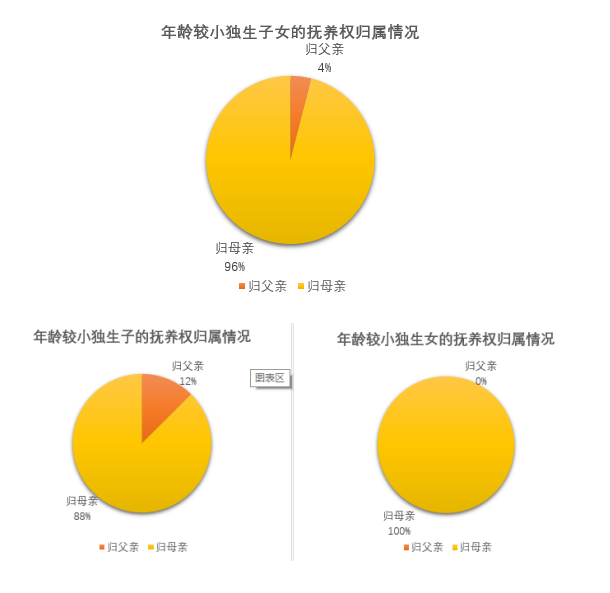
Among 25 marital and family dispute cases involving custody of younger only children, there was only one instance where the court awarded custody of the younger child to the father. The court’s reasoning was that the child had been living with the father for a long time and was already attending school nearby, making it inappropriate to change the child’s environment. Additionally, the mother’s family members had a history of drug abuse, which was detrimental to the child’s upbringing. [Case (2014) Shenzhen Intermediate People's Court Civil Final Judgment No. 1800]
(4) Custody of Only Children Aged 10 and Above — Court Rulings Generally Align with the Child’s Preferences
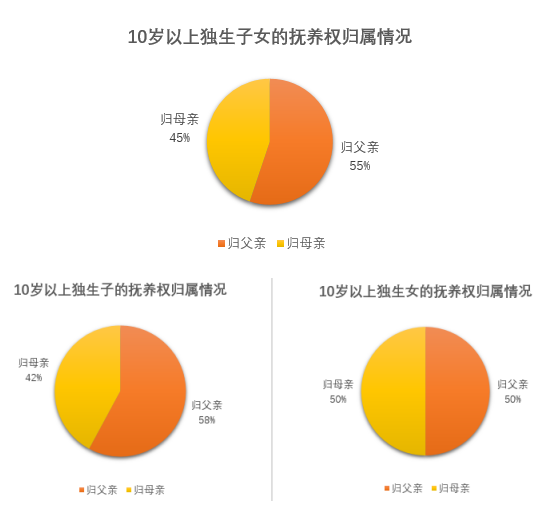
According to Article 6 of China’s “Several Specific Opinions on the Handling of Child Custody Issues in Divorce Cases by People’s Courts”: “Where both parents dispute whether a minor child aged 10 or older should live with the father or the mother, the child’s opinion shall be taken into consideration.” ” In 29 family law cases involving the custody of only children aged 10 or older, whenever the court consulted the child’s wishes, the court’s decision on custody generally aligned with the child’s wishes.
There was only one exception: in that case, after consulting the child, the court did not award custody to the mother—who did not wish to raise the child—but instead granted custody to the father, who expressed a willingness to do so.
3. The Degree of Influence of Various Factors on a Parent’s Efforts to Obtain Custody of a Child
(1) The Only Child is Mainly Raised by the Father / Mother for A Long Time.
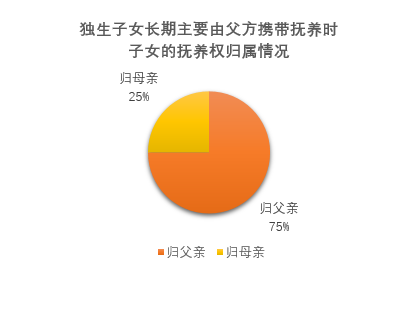
There were a total of 20 cases in which an only child had been primarily raised by the father over a long period. In 15 of these cases, the court awarded custody to the father, accounting for 75% of the total. In this context, the proportion of cases in which the court awarded custody to the mother was significantly lower, with 5 such cases, accounting for 25%.
In summary, the primary reason the court awarded custody to the mother in these cases was that the child was still young and it was deemed more appropriate for the child to live with the mother.
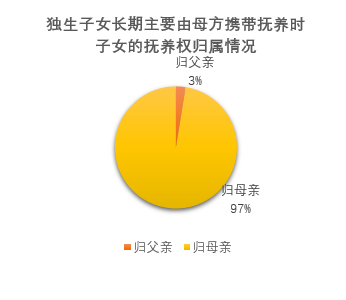
There were 79 cases involving only children who had been primarily raised by their mothers over a long period. In 77 of these cases, the court awarded custody to the mother, accounting for 97%. In this context, there were only 2 cases where the court awarded custody to the father, accounting for just 3%.
(2) Percentage of cases in which only the father / mother has assisted foster care taken into account in the court 's decision
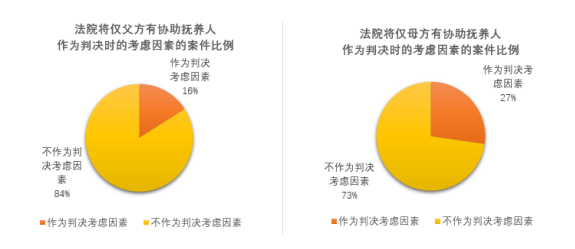
There were 11 cases where the presence of a caregiver assisting only the mother was a factor. In 3 of these cases (27%), the court considered the mother having a caregiver assisting her as a factor in awarding child custody.
The analysis reveals that the court only considers this factor as a primary determinant in awarding child custody when the father and mother are otherwise equally qualified.
(3)Cases in which the court took the child 's long life with the grandparents / maternal grandparents as a factor in the decision
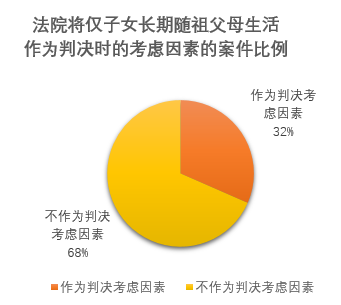
There were a total of 38 cases involving the factor of the child living long-term with one set of grandparents. In 12 of these cases, the court considered this factor when determining child custody, accounting for 32% of the total. Of the 12 cases in which the court considered this factor in determining child custody, the father was awarded custody in 11 cases, accounting for 91.6%.
It should be noted that in cases where the court considered the child’s long-term residence with one set of grandparents as a factor in determining custody and ultimately awarded custody to the father, the court invariably concluded that the child had been living with the father for an extended period.
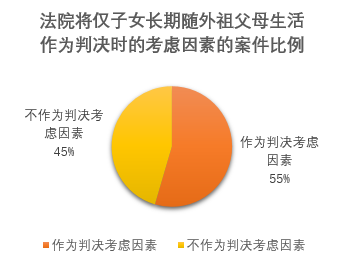
There were a total of 22 cases involving the factor of the child living with the grandparents / maternal grandparents for an extended period. In 12 of these cases—accounting for 55%—the court considered the child’s long-term residence with the grandparents / maternal grandparents as a factor in determining custody. In all cases where the court considered this factor, custody was awarded to the mother.
Analysis reveals that when determining child custody, courts generally do not treat whether the child has lived with the grandparents / maternal grandparents on a long-term basis as a primary factor, but rather as a secondary consideration.
In the divorce dispute between Li and Chi [Case (2014) Guangzhou Intermediate People's Court Civil Final Judgment No. 5794], the court explicitly stated in its reasoning: “The primary responsibility for raising children lies with the parents; intergenerational child-rearing inevitably has adverse effects on the children, and grandparents should primarily assist in raising their grandchildren.”
(4) Affiliation of the child 's right to custody when only the father / mother has no fertility
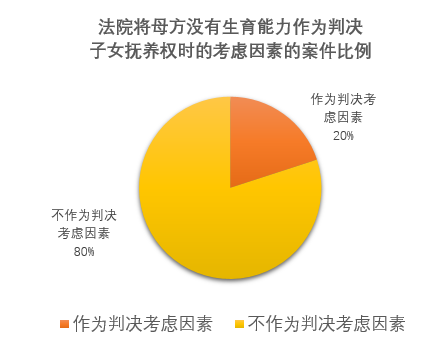
There were a total of 5 cases involving situations where only the mother was infertile. In these 5 cases, the court did not automatically award custody to the mother.
Among them, there was only 1 case—accounting for 20%—where the court considered one party’s infertility as a factor in its ruling. In that case, the court awarded custody of the son to the mother, who had lost her fertility, and custody of the daughter to the father, who had not lost his fertility.
Furthermore, since none of the 287 valid judgments collected involved cases where only the father was infertile, it is not possible to analyze the impact of this factor on the father’s ability to secure custody of the children.
(5) The ownership of children 's custody when the father / mother suffers from a long-term infectious disease or other diseases
Among the 287 valid judgments, there were 3 cases where the father alone suffered from an incurable infectious disease or other illness that made it unsuitable for the child to live with him long-term. In all 3 cases, the court considered this factor when determining custody, representing 100% of such cases.
In one of these cases, the court awarded custody to the father [(2014) Guangzhou Intermediate People's Court Civil Final Judgment No.7129], while in the other two cases, the court awarded custody to the mother.
There was one case where the mother alone suffered from a chronic, incurable infectious disease or other illness that made it unsuitable for the child to live with her long-term [Case (2015) Guangzhou Intermediate People's Court Civil Final Judgment No. 1106]. However, the court determined that the mother’s condition was not severe enough to render her unfit to raise the child, and therefore awarded custody to the mother.
In summary, when the court determined that the father’s or mother’s medical condition was sufficient to render it unsuitable for the child to live with them, the court consistently treated this as a primary factor in awarding custody to the other parent.
(6)The ownership of the child 's custody when the father / mother has custody conditions and fails to fulfill the custody obligation
There were two cases where the father had the capacity to provide support but failed to fulfil his obligations; in both cases, the court awarded custody to the mother. Furthermore, since the children had been living with the mother for an extended period in cases where the father had the means to provide support but failed to do so, the courts consistently treated the children’s long-term residence with the mother as a primary factor in their rulings and awarded custody to the mother. [Case (2014) Shenzhen Intermediate People's Court Civil Final Judgment No. 936;(2014) Shenzhen Intermediate People's Court Civil Final Judgment No. 2086]
Furthermore, since none of the 287 valid judgments collected involved cases where the mother had the capacity to provide care but failed to fulfill her obligations, it was not possible to analyze the impact of this factor on the mother’s ability to secure custody of the children.
(7) The ownership of children 's custody when the father / mother has other children
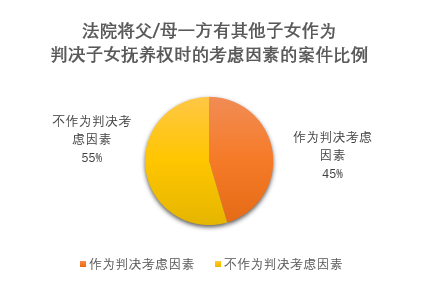
There were 18 cases where the father had other children. In 9 of these cases, the court considered this factor in determining child custody, accounting for 50% of the total.
In contrast, there were 4 cases where the mother had other children. In 1 of these cases, the court considered this factor in determining child custody, accounting for 25% of the total.
(8)The ownership of children 's custody when the father / mother has a bad habit of life
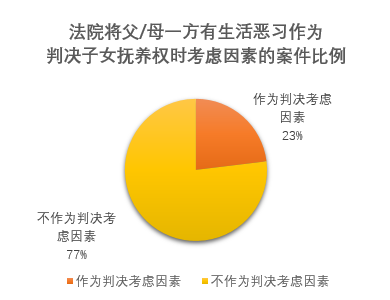
There were 13 cases where one parent had a habitual vice. In 3 of these cases, the court considered this factor in determining custody, accounting for 23%.
It is worth noting that in one of these cases, although the mother had a gambling problem, the court still awarded custody to the mother because the child was under two years of age; regarding the mother’s gambling problem, the court merely recommended that she correct her behavior.
In another case, although the father had a drug addiction, the court did not consider this a primary factor because his drug use was related to his wife’s infidelity.
(9) Custody Allocation When One Parent (Father/Mother) Is Unfaithful
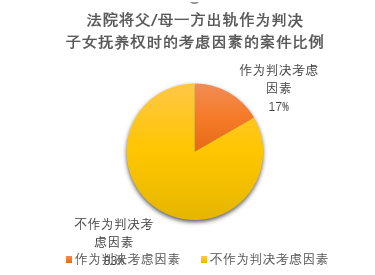
There were 12 cases involving infidelity by either the father or the mother. The court considered this factor in determining child custody in only 2 of these cases, accounting for 17%, and in neither case was it considered a primary factor.
(10)The ownership of children 's custody when the father / mother has housing
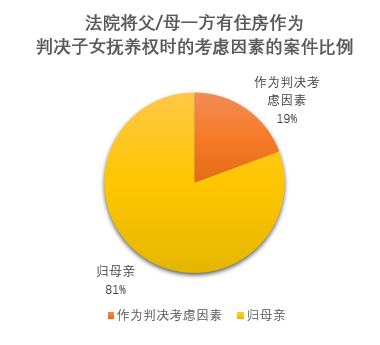
There were a total of 31 cases where one parent owned a home. The court considered this factor in determining child custody in 6 of these cases, accounting for 19%. Additionally, due to the impact of school district housing policies, if a child is attending school in or near the home due to school district requirements, and if the parents’ other conditions are comparable, the court places significantly greater emphasis on this factor when determining child custody.
III. Conclusions from the Big Data Report on Child Custody
The above is an analytical report prepared by Attorney Li Xiaofei and his team of family law attorneys in South China, examining valid second-instance judgments in family law disputes concerning child custody within the jurisdictions of the Intermediate People’s Courts of Guangzhou, Foshan, and Shenzhen. The report reveals the following characteristics: First, disputes over child custody are the central issue in family law cases; Second, the implementation of the two-child policy has had a significant impact on courts’ rulings regarding child custody; third, the principle of the best interests of the child is fully reflected in court rulings on child custody; and finally, the role of specialized attorneys in marriage and family cases is recognized by the parties involved.
(1) Child Custody Is the Central Issue in Marriage and Family Disputes
Among the 287 valid judgments studied, there were 159 cases (56%) in which the parties were dissatisfied with the court’s first-instance ruling on child custody and filed an appeal. Furthermore, in the marital and family disputes examined, the greatest controversy arose between the parties regarding the custody of an only child. Among the 138 family dispute cases involving the custody of an only child, 85 cases (62%) involved parties appealing the first-instance court’s decision on custody. Even though China has now fully liberalized the two-child policy, due to various practical factors, the desire to obtain child custody is unlikely to diminish in the short term.
(2) The Impact of the Two-Child Policy on Child Custody
China fully liberalized the two-child policy in 2016. Analysis reveals a marked difference in how courts handled custody disputes involving multiple children before and after 2016. After the full liberalization of the two-child policy, among the four valid court rulings included in this report, there were three cases where the court awarded custody of all children to one parent, accounting for 75% of the total—a 45-percentage-point increase compared to previous years. Prior to the full liberalization of the two-child policy, if there was no significant disparity in the parties’ ability to provide for the children, courts tended to rule more frequently that the children be placed in separate households when adjudicating custody disputes involving multiple children.
(3) The Principle of Maximizing the Interests of the Child Is Fully Reflected in Court Rulings
Analysis of the impact of various factors on child custody determinations reveals that courts place varying degrees of emphasis on different factors when rendering such decisions. First, regarding the child’s basic circumstances, three factors were analyzed: the child’s age, the type of child, and the child’s gender. Among these, the courts placed the highest emphasis on the child’s age and the lowest on the child’s gender. For younger children, court rulings tended to favor awarding custody to the mother. For children aged 10 or older, the courts generally respected the child’s personal wishes.
Second, five factors that favor one party in obtaining custody were analyzed: whether the child has been primarily cared for by one parent over the long term; whether the child has been assisted in care by one parent’s parents over the long term; whether one party has a caregiver to assist with child-rearing; whether one party has lost the ability to bear children; and whether one party owns a home. The analysis revealed that courts place great emphasis on the child’s long-term living environment when rendering judgments. The proportion of cases where courts considered the factor of the child having been primarily cared for by one parent over the long term was 100%, while the proportions for cases considering the factor of the child having been assisted in care by grandparents (paternal or maternal) were 32% and 55%, respectively.
Finally, five factors that work against a parent’s ability to obtain child custody were analyzed: whether a parent suffers from a chronic infectious disease or other illness, whether a parent fails to fulfill their child support obligations, whether a parent has other children, whether a parent has harmful lifestyle habits, and whether a parent has been unfaithful. The analysis revealed that the court considered the factors of one parent suffering from a chronic infectious disease or other illness and one parent failing to fulfill their child support obligations in 100% of cases. However, for the other three factors, the proportion of cases in which the court considered them was relatively low.
(4) The Role of Professional Lawyers in Family Law Cases Is Recognized by the Parties
Among the 287 valid judgments, there were 13 cases where the second-instance court reversed the original ruling regarding child custody. In all 13 of these cases, the party whose appeal was upheld had retained legal representation. Furthermore, in the three cases where children under the age of two were awarded to the father, the fathers had all retained legal representation. The data indicates that the role of professional lawyers in matrimonial and family law cases is widely recognized by the parties involved.