


Judicial Practices One Year After the Implementation of the Anti-Domestic Violence Law, as Seen Through Nearly 1,000 Rulings
—With a Discussion on the Rights Protection of Women Victims of Domestic Violence
Foreword
On March 1, 2016, China’s Anti-Domestic Violence Law officially came into effect. The enactment and implementation of this law reflect the protection of the rights and interests of domestic violence victims; however, fully realizing its potential still requires continuous exploration and reflection in judicial practice.
Led by Attorney Li Xiaofei, the South China Family Law Team, in collaboration with the Guangzhou Hehe Family Affairs Center, analyzed nearly a thousand divorce cases involving domestic violence in Guangdong Province in 2016 and compiled the findings presented in this report.
This report is organized into three sections: an analysis of basic circumstances, judicial practices in divorce cases involving domestic violence, and the status of women’s rights protection in such cases. It summarizes and examines the judicial practices of the courts regarding divorce cases involving domestic violence since the implementation of the Anti-Domestic Violence Law one year ago, as well as the status of women’s rights protection in these cases, objectively reflecting the awareness of rights protection among women affected by domestic violence and the current state of their rights protection in such divorce proceedings.
Part I: Analysis of Basic Conditions
Case Sources
The cases in this report were selected from the Jufa Case Database. The base data consists of all divorce cases involving domestic violence in Guangdong Province that were made available online in 2016 (including those concluded at both the first and second instance levels), totaling 965 cases. After screening and removing divorce cases where the substantive issues did not involve domestic violence, a total of 735 valid cases were selected. All statistical data in this report are derived from these 735 valid cases.
I. Proportion of Divorce Cases Involving Domestic Violence in Guangdong Province
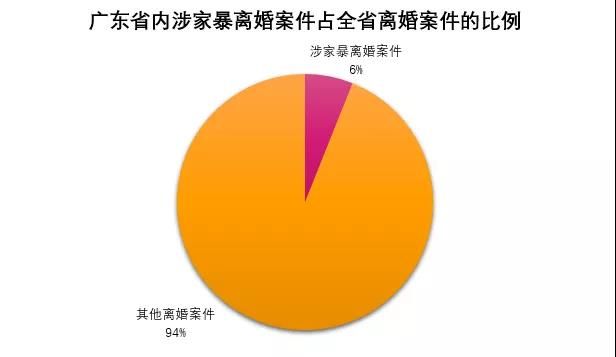
In 2016, there were a total of 8,036 divorce cases in Guangdong Province, of which 12% involved domestic violence. (Note: The term “divorce cases” here refers exclusively to cases concluded by court judgments.)
II. Age and Gender of Private Prosecution Victims
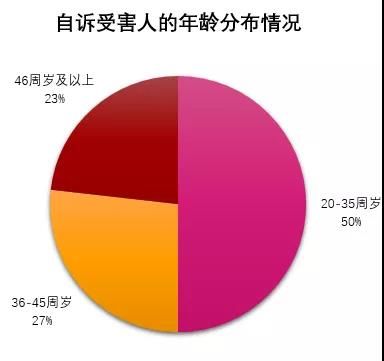
Among the 735 valid judgments, 50% of the self-prosecuting victims were between the ages of 20 and 35. The proportion of individuals born in the 1980s and 1990s who alleged domestic violence by their spouses in divorce cases was relatively high.
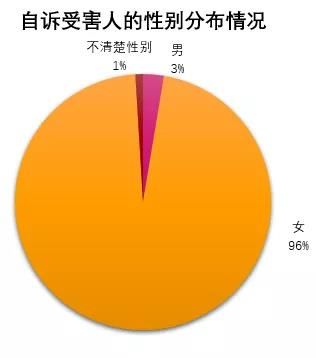
Furthermore, in terms of gender, 96% of the self-prosecuting victims were female; only 19 male self-prosecuting victims were identified in the collected data. (Note: Regarding the age of private prosecution victims, the statistical calculations are based on 2016.)
III. Legal Status of Private Prosecution Victims
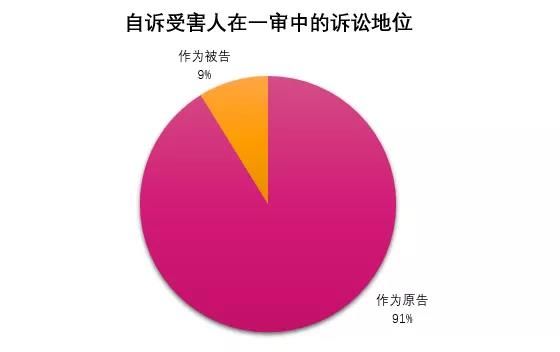
Over 90% of private prosecution victims were plaintiffs in the first-instance trials of divorce cases involving domestic violence.
IV. Evidence Submission by Private Prosecution Victims
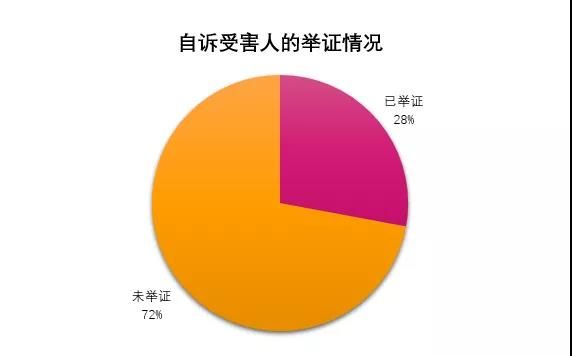
Only 28% of private prosecution victims submitted evidence to the court regarding their partner’s domestic violence.
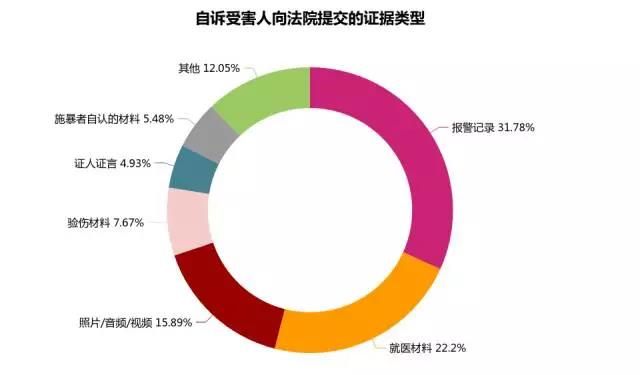
Furthermore, in terms of evidence types, the evidence submitted by self-prosecuting victims to the court primarily consisted of police reports (31.78%), medical records (22.2%), photographs/audio/video (15.89%), injury examination reports (7.67%), witness testimony (4.93%), and materials in which the perpetrator admitted to having committed domestic violence (5.48%) .
Very few cases involved private prosecution victims submitting materials such as warning letters, personal safety protection orders, or certificates issued by the Women’s Federation and village/neighborhood committees as evidence to the court.
It is evident that the types of evidence submitted by private prosecution victims to prove the other party’s domestic violence are relatively limited. At the same time, the application of warning letters and personal safety protection orders—evidence types specific to the Anti-Domestic Violence Law—remains very uncommon.
V. Cases in Which Self-Prosecuting Victims Sought Damages
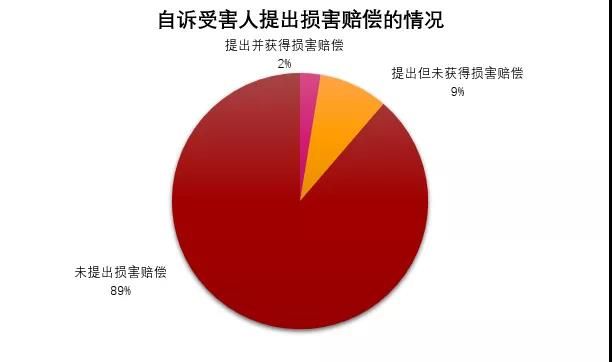
In all divorce cases involving domestic violence, self-prosecuting victims who filed claims for damages with the court accounted for only 11% of the total. Furthermore, the proportion of cases in which self-prosecuting victims filed claims for damages and received court support was only 2%.
Part II: Judicial Practice in Divorce Cases Involving Domestic Violence
I. Court Findings in Divorce Cases Involving Domestic Violence
(1) Overall Court Findings in Divorce Cases Involving Domestic Violence
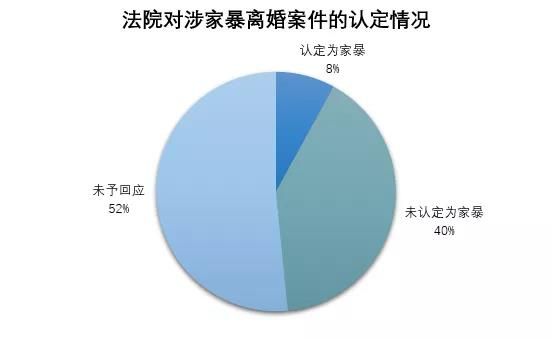
In 52% of the cases, the courts did not address the victim’s claim that the other party had committed domestic violence.
Furthermore, in 40% of the cases, the courts did not find that either party had committed domestic violence.
Among the 735 valid judgments, courts found that one party had committed domestic violence in only 8% of the cases.
(2) Court Findings in Domestic Violence Divorce Cases Where the Plaintiff-Victim Provided Evidence
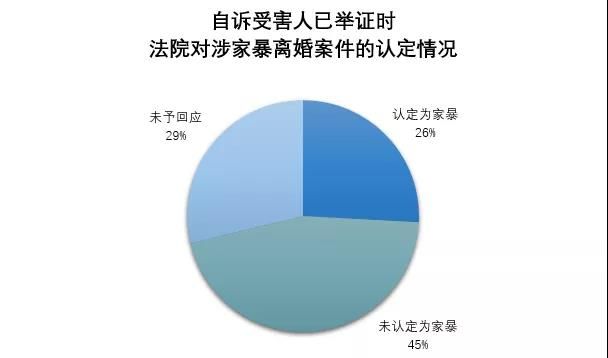
In cases where the self-prosecuting victim presented evidence to the court regarding the other party’s domestic violence, the court found domestic violence on the part of one party in 26% of cases, while in 45% of cases, the court did not find domestic violence on the part of one party.
II. Specific Analysis of Divorce Cases Where the Self-Prosecuting Victim Has Presented Evidence and the Court Has Found Domestic Violence on the Part of One Party
(I) Evidence Presentation by the Self-Prosecuting Victim in Cases Where the Court Found Domestic Violence on the Part of One Party
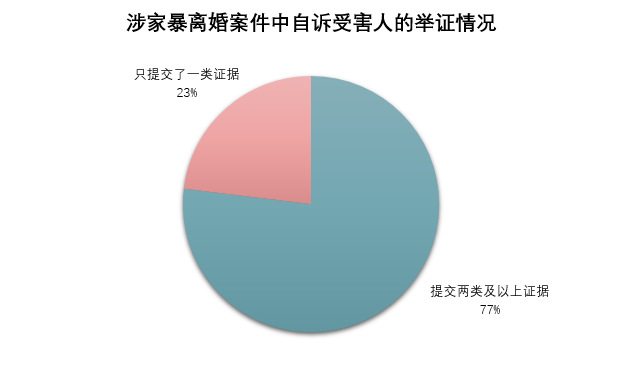
In cases where the plaintiff’s claims were upheld by the court, 77% of the plaintiffs submitted two or more types of evidence regarding the other party’s domestic violence.
In the remaining 23% of cases, the plaintiffs submitted only one type of evidence regarding the other party’s domestic violence.
(2) Court Handling of Claims for Damages in Cases Where Domestic Violence Was Found
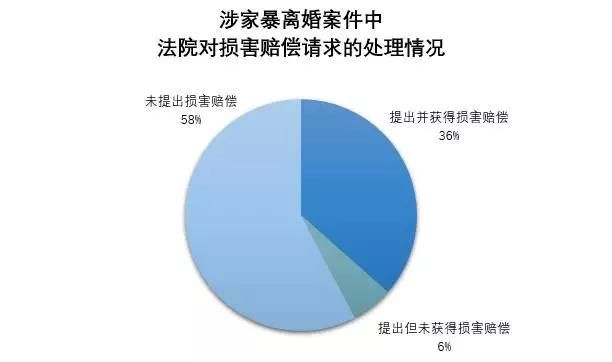
In the 52 divorce cases (26% of the total) where the self-prosecuting victim presented evidence to the court and the court found domestic violence to have occurred, 22 cases (42%) involved claims for damages.
In 19 cases, claims for damages were filed and granted, accounting for 86% of the cases in which such claims were filed. The number of cases where claims for damages were filed and supported by the court was six times that of cases where claims were filed but not supported.
It is evident that, provided the court has determined that one party engaged in domestic violence, the court’s acceptance rate of claims for damages filed by the self-prosecuting victim is relatively high.
III. Specific Analysis of Cases Where the Self-Prosecuting Victim Provided Evidence but the Court Did Not Find Domestic Violence
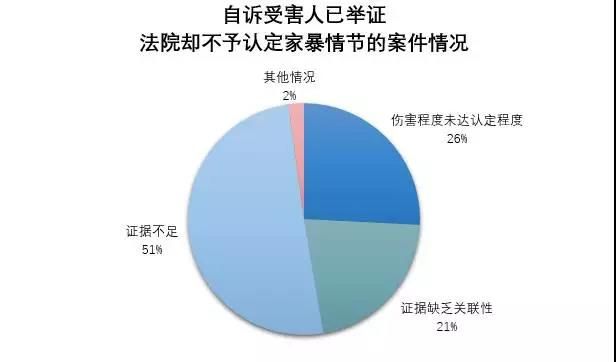
In cases where the self-prosecuting victim has presented evidence to the court regarding the other party’s domestic violence but the court has not accepted it, the court’s reasons for rejection primarily fall into the following three categories: the evidence is insufficient to establish domestic violence; the evidence lacks relevance, making it impossible to confirm that the perpetrator of the violence is the other party in the marital relationship; and the extent of injury indicated by the evidence is insufficient to establish domestic violence.
IV. A Detailed Analysis of Cases Where the Self-Prosecuting Victim Has Presented Evidence but the Court Has Not Responded
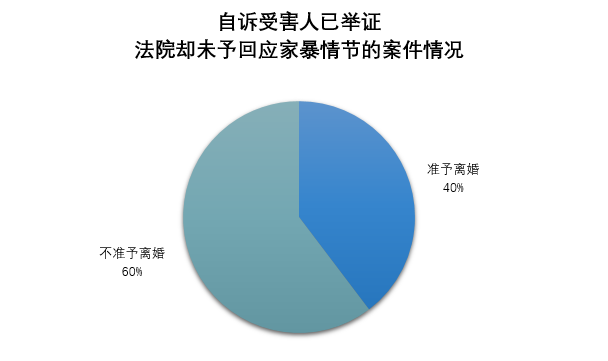
In cases where the self-prosecuting victim alleges domestic violence by the other party and presents evidence to the court but receives no response, the court’s disposition of the case falls into two main categories: granting a divorce and denying a divorce.
Among these, the proportion of cases where divorce was granted is significantly lower than that of cases where it was denied, accounting for only 40%; conversely, the number of cases where divorce was denied is approximately 1.5 times that of cases where it was granted, accounting for 60%.
Part III: The Status of Women’s Rights Protection in Divorce Cases Involving Domestic Violence
Note : Among the 735 valid judgments collected in this report, a total of 701 judgments in which the victims of private prosecution are women. Therefore, the 701 judgments are used as basic data to analyze the situation of women 's rights protection in divorce cases involving domestic violence.
I. Situation of Self-Relief for Female Complainant-Victims
(1) Female Complainants Seeking Assistance from Third Parties Due to Domestic Violence
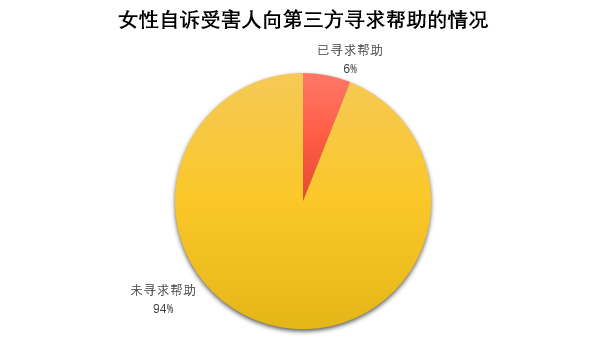
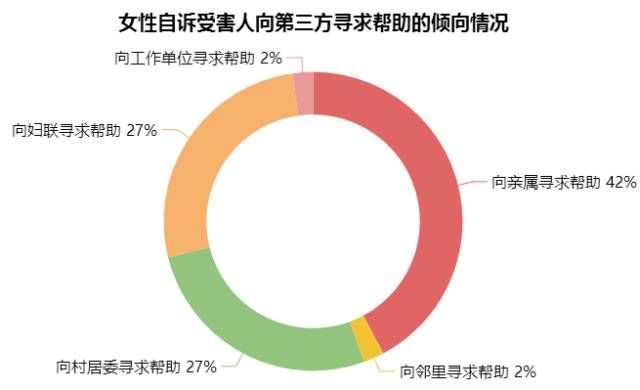
Among the 701 domestic violence-related divorce cases where the self-reported victim was female, only 6% of these female victims sought help from third parties.
More than 40% of female victims tended to seek help from relatives. At the same time, nearly 30% of female victims tended to seek help from village or neighborhood committees and the Women’s Federation.
(2) Female self-prosecuting victims seeking third-party mediation due to domestic violence
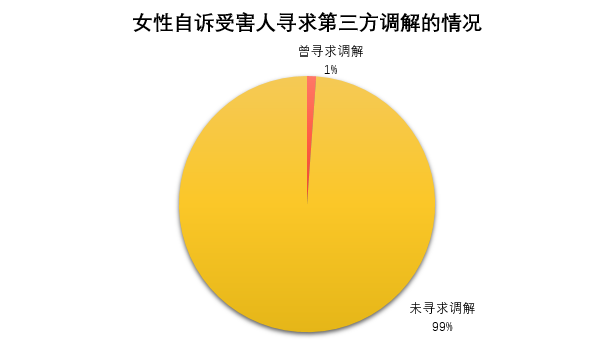
(3) Female self-prosecuting victims reporting domestic violence to the police
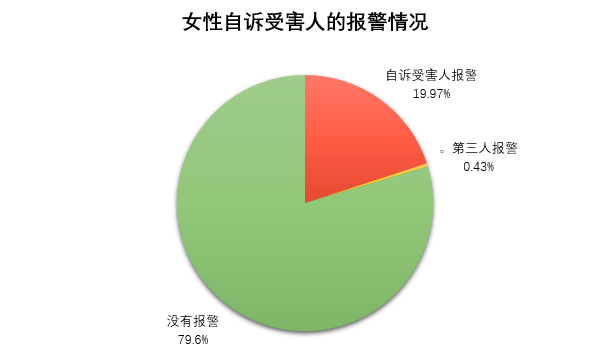
The proportion of female self-prosecuting victims seeking third-party mediation due to domestic violence within their marital relationships is low; only 8 female self-prosecuting victims and their husbands underwent third-party mediation, accounting for 1%.
In contrast, the proportion of female self-prosecuting victims who reported the violence to the police was relatively high, accounting for 19.97%.
II. Awareness of Judicial Remedies Among Female Self-Prosecuting Victims
(I) Cases Where Female Self-Prosecuting Victims Retained Lawyers or Citizen Representatives
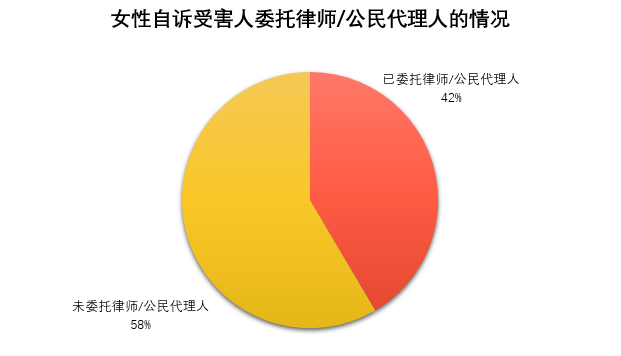
Among the 701 divorce cases involving domestic violence where the self-prosecuting victim was female, 42% of these victims retained lawyers or citizen representatives.
(2) Cases in Which Female Self-Prosecuting Victims Sought Damages
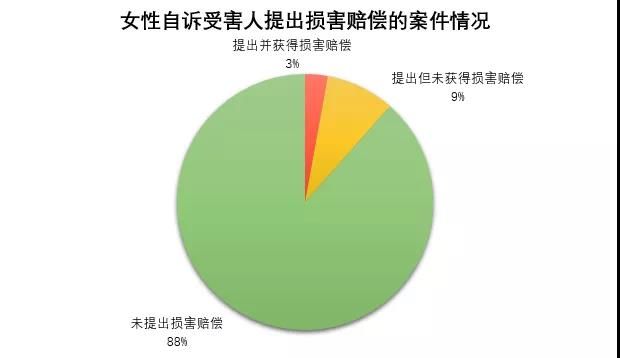
Among the 701 divorce cases involving domestic violence where the self-prosecuting victim was female, 12% of these victims sought damages from the court, with 25% of those cases receiving court support. However, the total proportion of cases where female self-prosecuting victims did not seek damages from the court was as high as 88%.
(3) Evidence Preservation by Female Self-Prosecuting Victims
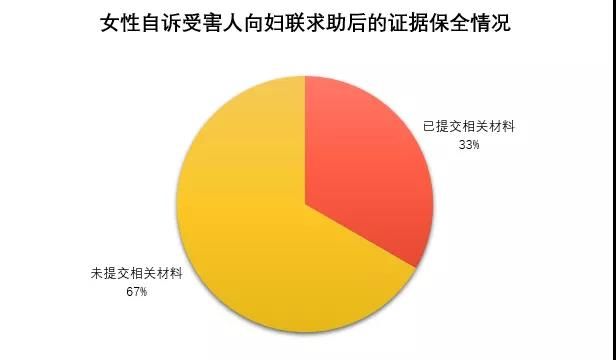
In cases where the female complainant-victims sought help from the Women's Federation, the proportion in which they submitted materials related to such assistance as evidence to the court was 50%.
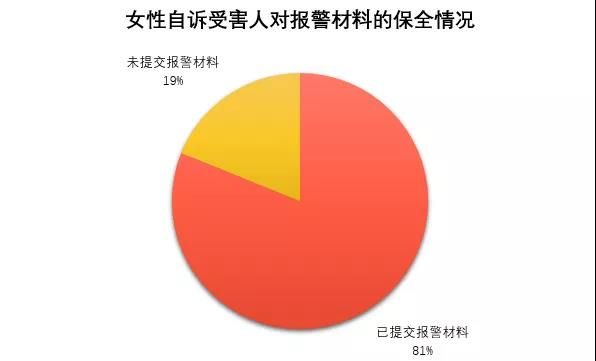
In cases where female complainant-victims sought police assistance due to domestic violence, the proportion in which they submitted police report materials to the court was 81%.
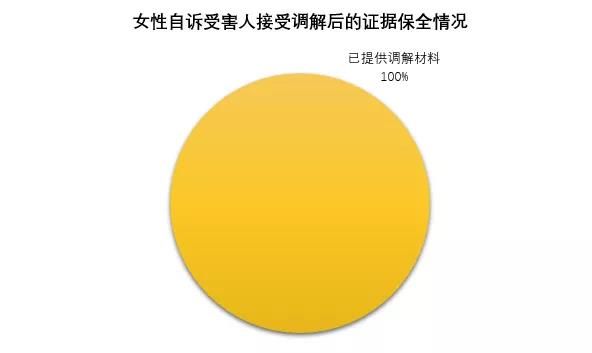
In cases where female self-prosecuting victims sought third-party mediation due to domestic violence, 100% of them submitted mediation records to the court.
Part IV: Summary of the Report
I. Factors Related to Domestic Violence Have Not Yet Received Sufficient Attention from Self-Prosecuting Victims in Divorce Cases
Among the 735 divorce cases involving domestic violence, 91% were initiated by self-prosecuting victims who filed for divorce with the court and alleged that their spouses had committed acts of domestic violence; however, only 28% of these self-prosecuting victims submitted evidence to the court.
At the same time, the types of evidence submitted by these victims to the court were relatively limited, consisting primarily of police reports, medical records, photographs/audio/video recordings, and medical examination reports. Among the cases analyzed, only a small number of victims submitted evidence forms explicitly stipulated by the Anti-Domestic Violence Law, such as written warnings, personal safety protection orders, and administrative penalty decisions.
Furthermore, the proportion of private prosecution victims seeking damages from the court is relatively low, at only 11%.
Article 32 of China’s Marriage Law explicitly stipulates that domestic violence by one party is one of the statutory grounds for divorce. As evidenced by the data presented in the report, self-prosecuting victims in domestic violence-related divorce cases do not place sufficient emphasis on this statutory ground for divorce. A significant portion of these victims merely verbally inform the court that the other party has committed acts of domestic violence, hoping to use this as a basis for requesting the court to grant a divorce, but they often do not present this as the primary ground for their petition.
Furthermore, because most self-prosecuting victims lack awareness of their rights following domestic violence, as well as a poor understanding of evidence and the ability to preserve it, their claims are unlikely to be supported by the court when they fail to provide sufficient evidence to substantiate their allegations.
II. The Court’s Determination of Domestic Violence Is Closely Linked to the Parties’ Ability to Present Evidence
Among the 735 valid judgments, cases in which the court found one party guilty of domestic violence accounted for only 8%. Notably, in cases where the plaintiff-victim had presented evidence to the court regarding the domestic violence they had suffered, the proportion of cases in which the court found one party guilty of domestic violence rose significantly to 26%.
In cases where the court found one party guilty of domestic violence, 77% of the self-prosecuting victims submitted two or more types of evidence to the court. Additionally, 36% of these victims successfully claimed and received compensation for damages, a rate significantly higher than the overall level reflected in the 735 valid judgments (in which only 2% of self-prosecuting victims’ claims for damages were supported by the court).
It is evident that when private prosecution victims provide relatively sufficient evidence to the court regarding the domestic violence they have suffered, the likelihood of the court finding that one party has committed domestic violence increases significantly, and the court’s support rate for claims for damages also rises accordingly.
However, since the majority of self-prosecuting victims either fail to present evidence to the court regarding the domestic violence they have suffered or provide insufficient evidence, the courts generally do not conduct an in-depth review of such cases. Consequently, they rarely grant the self-prosecuting victims’ claims and may even fail to respond to them at all.
III. Courts Adopt a Rigorous Approach to Determining Domestic Violence; Occasional Verbal or Physical Alterations Between Spouses Are Generally Not Recognized as Domestic Violence
In cases where the victim has presented evidence of domestic violence to the court but the court has not found that one party committed such acts, the court’s refusal to uphold the victim’s claims is primarily based on the following three reasons: insufficient evidence to establish domestic violence; lack of relevance in the evidence, making it impossible to confirm that the perpetrator was the other spouse; and the extent of injury indicated by the evidence being insufficient to constitute domestic violence.
Statistics show that courts adopt a rigorous approach when determining acts of domestic violence, primarily considering whether the acts are persistent and the severity of the violence.
Courts generally do not classify an occasional act of violence by one party as domestic violence. However, when such an occasional act results in a certain degree of injury, the court may classify it as domestic violence. In Case (2016) Guangdong Shaoguan Shixing County People's Court Civil Judgment No. 289, because one party’s violent act caused the other party to suffer a Grade 9 disability, the court determined that the party who committed the violent act had committed domestic violence.
IV. Limited Self-Help Capacity Among Female Victims in Private Prosecution Cases
Among the 701 divorce cases involving domestic violence where the victim was a female private prosecutor, few women had sought outside assistance due to domestic violence; only 6% of female victims had sought help from a third party. Statistics show that female victims in private prosecution cases tend to seek help from the Women’s Federation, close relatives, and village or neighborhood committees.
The proportion of female self-prosecuting victims who reported domestic violence to the police or accepted third-party mediation was relatively low.
Among the cases analyzed, only 8 female self-prosecuting victims and their husbands had undergone third-party mediation. In contrast, the number of female self-prosecuting victims who reported violence to the police was relatively high, with a total of 140 female self-prosecuting victims having sought assistance through police reports.
V. Low Capacity of Female Self-Prosecuting Victims to Utilize Judicial Remedies
The proportion of female self-prosecuting victims who retained legal representation was 42%. In cases where legal representation was retained, the proportion of cases in which the female self-prosecuting victims’ claims were upheld by the court was higher than in cases where no representation was retained. Additionally, the proportion of female self-prosecuting victims who sought damages was low, at only 12%.
An analysis of 701 divorce cases involving domestic violence where the self-prosecuting victim was female revealed that female self-prosecuting victims’ ability to preserve evidence was significantly weak. The evidence preservation rate for female self-prosecuting victims regarding assistance materials from the All-China Women’s Federation was 50%, while the rate for police reports was higher, reaching 81%. However, the evidence preservation rate for cases that had undergone mediation reached 100%.
The ability of female self-prosecuting victims to preserve evidence depends not only on their awareness of the need for evidence preservation but is also influenced by the difficulty they face in obtaining various types of evidence.