


There are generally two ways for parents to pass down real estate to their children:
First, parents may make a will specifying that the property shall be inherited by their children upon their decease.
Second, parents may gift the property to their children during their lifetime.
Each of the two methods has its own advantages and disadvantages. Under the first method, since inheritance tax has not yet been levied in mainland China, the tax cost for children to obtain the property by inheritance is relatively low. However, children still face certain inheritance-related risks, and need to provide relevant supporting documents as well as bear the costs of inheritance notarization.
Under the second method, children can avoid inheritance risks and the relevant documentary procedures and expenses for inheritance notarization. Nevertheless, they shall bear the taxes and fees arising from property title transfer. In addition, if children sell the property acquired by parental gift in the future, they will be subject to 20% individual income tax.

Therefore, in judicial practice, parents and their children often sign a housing sales contract to complete property title transfer to the child so as to evade individual income tax. However, such arrangement — whereby parents complete title registration transfer of the property to their married child by way of sale during the child’s marriage — carries enormous legal risks. Once the child’s marital relationship breaks down, major disputes will arise over whether the property share qualifies as the child’s personal property.
Let us look at a real case that occurred in Guangzhou:
Case Brief
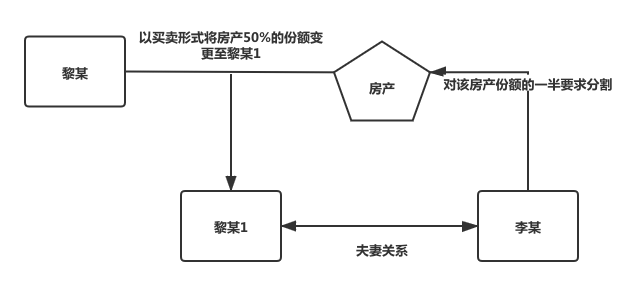
Li Yi and Li Mou are husband and wife. During the subsistence of their marital relationship, Li Yi’s father transferred 50% of the property ownership registered under his own name to Li Yi by way of a housing sales contract.
Thereafter, the marital relationship between Li Yi and Li Mou broke down. When dividing property upon divorce, Li Mou claimed that the 50% property share constituted marital joint property. By contrast, Li Yi firmly argued that the property share was a gift made by his parents solely to himself, belonging to his personal property, and refused to agree to its partition.
Hearing Court: Guangzhou Intermediate People’s Court
Case No: (2018) Yue 01 Min Zhong No. 11216
Court Judgment
The court of first instance found that the written Certificate provided by Li Yi and issued by his father Li bore printed text for its title, main content and signature date. Its actual formation time could hardly be confirmed, and the possibility of being prepared afterwards could not be ruled out.
Furthermore, even if the Certificate was made at the time of the gift, it is the general rule that property acquired by spouses through donation during the subsistence of marital relationship shall be deemed marital joint property; it constitutes an exception where the donor clearly donates the property only to one spouse alone.
If Li Yi claimed that his father Li donated only the 50% property share of the involved real estate exclusively to him personally, he was obligated to adduce corresponding evidence to prove that the aforesaid Certificate was disclosed to Li Mou at the time of donation, or filed and registered with relevant authorities with public notice and notarization effect.
Accordingly, the court of first instance held that where Li donated the 50% property share of the involved real estate to Li Yi and completed registration under Li Yi’s name during the marriage of Li Yi and Li Mou, such property share shall be deemed marital joint property of the two, unless Li explicitly stated that the donation was made solely to Li Yi personally.
Li Yi refused to accept the first-instance judgment and filed an appeal with the Guangzhou Intermediate People’s Court.
The court of second instance affirmed the facts ascertained by the first-instance court. It held that in accordance with Article 17 and Item 3 of Article 18 of the Marriage Law, property gifted to a spouse shall generally be regarded as marital joint property, unless it is clearly stipulated to be donated only to one spouse. Therefore, the party claiming the gifted property as personal property shall bear the burden of proof.
Such burden of proof covers two aspects:
- The donor has made a clear expression of intent to donate the property solely to one spouse.
- The expression of intent to donate was made at the time of donation and shall not be retrospectively confirmed afterwards.
In this case, Li Yi acquired the 50% property share of the involved real estate by way of donation during his marriage, which shall legally belong to the marital joint property of Li Yi and Li Mou. Li Yi appealed and claimed that the 50% property share was personally gifted to him by his father Li, yet he only submitted the Certificate issued by Li. Li Mou denied such claim and provided two audio recordings and one video material as corroborating evidence.
The first-instance court ascertained the facts of the case based on the claims, defenses and evidence submitted by both parties, and rendered the first-instance judgment in accordance with law, which is legitimate, reasonable and sufficiently reasoned. The appellate court hereby confirms and upholds the original judgment.
In conclusion, upon trial by both the first and second instance courts, the 50% property share of the involved real estate was identified as marital joint property and divided accordingly.
Legal Commentary
Where parents transfer real estate title to their married children by way of housing sales transaction as a means of property inheritance, disputes are inevitable among the three parties — the child’s spouse, the parents and the child — once the child’s marital relationship breaks down. To safeguard legitimate rights and interests, the author summarizes the court’s adjudication criteria in judicial practice from the perspectives of the three parties respectively and puts forward the following suggestions:
1. From the Perspective of the Child’s Spouse
The child’s spouse usually claims that the real estate was purchased by the child. Property acquired by a spouse through purchase during marriage is generally presumed to be marital joint property, unless the child can prove that the purchase funds derive from his or her pre-marital personal property. The spouse shall therefore bear the burden of proving that the property was purchased by the child.
Although a housing sales contract is signed between parents and the child, the two often argue that the contract does not reflect their true mutual intent. Whether the child has paid the house price in full pursuant to the sales contract serves as a key basis for adjudication. The spouse still needs to adduce evidence proving full payment of the house price by the child. Otherwise, even with the signed sales contract, the court may not recognize that the child acquired the property by way of purchase.
It is therefore suggested that the spouse timely collect relevant communication records such as WeChat messages, SMS and phone call recordings proving the true sales intent between parents and the child, and properly preserve all payment vouchers for the house price, to be used as evidence of acquisition by purchase in future disputes.
2. From the Perspective of the Parents
Parents often claim that the involved real estate is held in trust by the child on their behalf, and that they remain the actual owner rather than the child, so as to prevent the property from being divided as marital joint property upon divorce.
In judicial practice, the court comprehensively determines the existence of property trust by examining whether a written property holding agreement was signed at the time of title transfer, whether there is reasonable motive and cause for holding in trust, whether the parents retained payment vouchers for the property purchase, the original real estate ownership certificate and relevant transaction tax invoices, as well as the actual occupancy and use of the property. Among them, the written property holding agreement is a core evidentiary basis for recognizing a trust relationship.
If the purpose of transferring the property to the child is for holding in trust, it is recommended that parents and the child sign a written property holding agreement when going through title transfer registration. Where conditions permit, the child’s spouse may sign for confirmation as well.
3. From the Perspective of the Child
The child usually claims that the property is a personal gift from the parents and thus belongs to his or her personal property.
Paragraph 4 of Article 1062 of the Civil Code stipulates that property acquired by inheritance or gift shall belong to marital joint property; however, property specified in a will or gift contract to belong exclusively to one spouse shall be the separate property of that spouse.
In addition, Paragraph 1 of Article 7 of Judicial Interpretation (III) of the Marriage Law (now repealed) provides that where one party’s parents contribute funds to purchase real estate for their child after marriage, and the property is registered under the child’s name, it may be deemed a gift made exclusively to their own child, and the real estate shall be recognized as the separate personal property of that spouse.
Many children simply assume that registration of the property under their sole name by parents constitutes a personal gift and should therefore be their separate property.
Although both scenarios reflect parental financial support for their children’s property acquisition, they adopt entirely different adjudication criteria and lead to vastly different legal consequences. Article 7 of Judicial Interpretation (III) of the Marriage Law applies only to the specific scenario where parents fund the purchase of real estate for their married child, and does not apply to the direct title transfer of parents’ existing property to the child during marriage. Even if registered solely under the child’s name, such property shall be deemed property acquired by gift and belong to the marital joint property of the child and his or her spouse.
It is therefore recommended that if parents intend to gift the property exclusively to their married child as separate personal property, they shall, in addition to registering the title solely under the child’s name, sign a separate gift agreement at the time of title alteration registration, clearly stipulating that the property is gifted only to the child personally as his or her separate property unassociated with any third party. This can effectively avoid the property acquired by gift being regarded as marital joint property and divided upon divorce.