A Comprehensive Overview of Jurisdiction · Combining Primary and Secondary Strategies · Red Lines for Procedural Abuse
In March 2026, the custody dispute between NBA Los Angeles Lakers star Luka Dončić and his former Slovenian fiancée, Gortés, made headlines around the world. Public opinion was almost unanimously focused on the claim that “Dončić refused to pay child support.”
But legal professionals saw an entirely different battle unfolding.
As early as February 2026, Dončić had filed a petition for custody and child support in a Slovenian court—more than a month before Gortés filed her lawsuit in California (as of this writing, the motion to dismiss for lack of jurisdiction is still pending). He hired “Divorce Queen” Laura Wasser to file not a response to the child support claim with the Los Angeles court, but a motion to dismiss for lack of jurisdiction—arguing that California lacks jurisdiction over the case. His central argument is that the two daughters have lived in Slovenia for a long time and lack a substantial connection to California; Gorttes’s decision to file in California is a “clear attempt to exploit differences in the laws of different jurisdictions to obtain a large amount of child support”¹.
- How Significant Is This “Legal Difference”?
California adopts a lifestyle-oriented standard, with no upper limit on alimony. According to media estimates, annual alimony payments may range from approximately USD 10 million to USD 15.3 million.In contrast, Slovenia determines alimony based on actual reasonable living costs, with an annual amount of approximately USD 1 million.The difference can be as much as 12 times.
Where the case is heard determines whether child support payments will vary dramatically. This isn’t a question of “whether to pay,” but rather “where the case is heard and under which law it is adjudicated.”
he Dončić case highlights a reality that is commonly underestimated in cross-border family law cases: the first battle is not over assets, but over jurisdiction. Yet many lawyers handling cross-border family law cases focus solely on jurisdiction within their own jurisdiction, lacking the awareness that “the opposing party might take the initiative in another jurisdiction first”—by the time they realize the opposing party has already filed a case abroad and try to respond, they have often lost the initiative. This blind spot is not due to negligence but stems from professional inertia: Mainland lawyers’ scope of practice is naturally limited to the Mainland, and their daily training rarely instills the awareness that “the opposing party might take the initiative abroad first”; meanwhile, parties in cross-border cases often only seek local counsel and will not proactively alert you that “the opposing party might file a case in Hong Kong.” Unless old habits are broken, the three-step approach cannot be applied.
This article proposes a three-step approach to jurisdiction strategies in cross-border family law cases: a comprehensive jurisdiction assessment, the combination of primary and secondary strategies, and red lines for abuse of process. Each step is accompanied by real-world case studies and legal analysis, providing a practical framework for addressing jurisdiction issues in cross-border family law disputes.
Step 1
Comprehensive Jurisdiction Assessment
When handling cross-border family law cases, the first step is not to draft a complaint, but to identify and compare all possible jurisdictions.
Many lawyers have a habit of assessing whether a case can be filed locally when a client comes to them, and if so, they begin preparing the materials. However, in cross-border cases, focusing solely on your own backyard is insufficient—while you’re determining whether a case can be filed locally, the opposing party may have already taken the initiative abroad. The Dončić case is a classic example: when Gortés filed a lawsuit in California, Dončić had already filed a case in Slovenia a month earlier. If you focus solely on your own jurisdiction, by the time you hear that the opposing party has filed a lawsuit abroad, you’ve often already lost the initiative.
Therefore, the first step is to conduct a “comprehensive scan”: list all jurisdictions that may be relevant to the client, compare the jurisdictional thresholds, differences in substantive law, and feasibility of enforcement one by one, and then decide where and how to proceed with the case.
Comparison of Jurisdictional Thresholds Between Mainland China and Hong Kong
Family law cases involving Hong Kong are the most common type of cross-border cases encountered by mainland lawyers. The Longhua District Court in Shenzhen is the first basic-level court in the country to have centralized jurisdiction over first-instance family law cases involving foreign parties, as well as those involving Hong Kong, Macao, and Taiwan. Between July 2022 and July 2025, it accepted a total of 2,783 cases, with cases involving Hong Kong accounting for nearly 70 percent².
Mainland China: Focus on the Defendant’s Place of Habitual Residence
Article 22³ of the Civil Procedure Law stipulates that jurisdiction lies with the court where the defendant has his or her domicile; if the defendant’s domicile and place of habitual residence are inconsistent, jurisdiction lies with the People’s Court at the place of habitual residence. In cross-border family law cases, the parties’ registered residence often differs from their actual place of residence; in practice, the most commonly cited criterion is the “place of habitual residence”—the location where the defendant has resided continuously for at least one year. For foreign-related status-of-person litigation, Article 23³ provides a supplementary connecting factor: for status-of-person lawsuits filed against persons not residing in China, jurisdiction lies with the court at the plaintiff’s domicile or place of habitual residence. Judicial interpretations by the Supreme People’s Court have further refined the jurisdiction rules for various scenarios involving foreign-related divorce—the core logic being that as long as one party has a domicile or place of habitual residence in China, mainland courts generally have jurisdiction.
Hong Kong: Three Progressive Thresholds
Pursuant to Section 3⁴ of the Matrimonial Causes Ordinance (Chapter 179) of the Laws of Hong Kong, it is sufficient to satisfy any one of the following three conditions:
- Domicile —
When applying for divorce, either party may rely on Hong Kong as their domicile.However, domicile does not equal permanent residency status; it requires a comprehensive assessment based on factors such as the person’s intention to reside in Hong Kong, family background, and overall circumstances. - Three Years’ Habitual Residence —
Either party must have been habitually resident in Hong Kong for three years immediately preceding the application. - Substantial Connection —
This is the lowest and most flexible jurisdictional threshold. It was established by the Hong Kong Court of Appeal in ZC v CN [2014] 5 HKLRD 43.
The case adopted a comprehensive approach, considering multiple factors, including whether one party remotely managed a Hong Kong company. Ultimately, the court held that the party had a substantial connection with Hong Kong. - Comparison Between the Two Jurisdictions
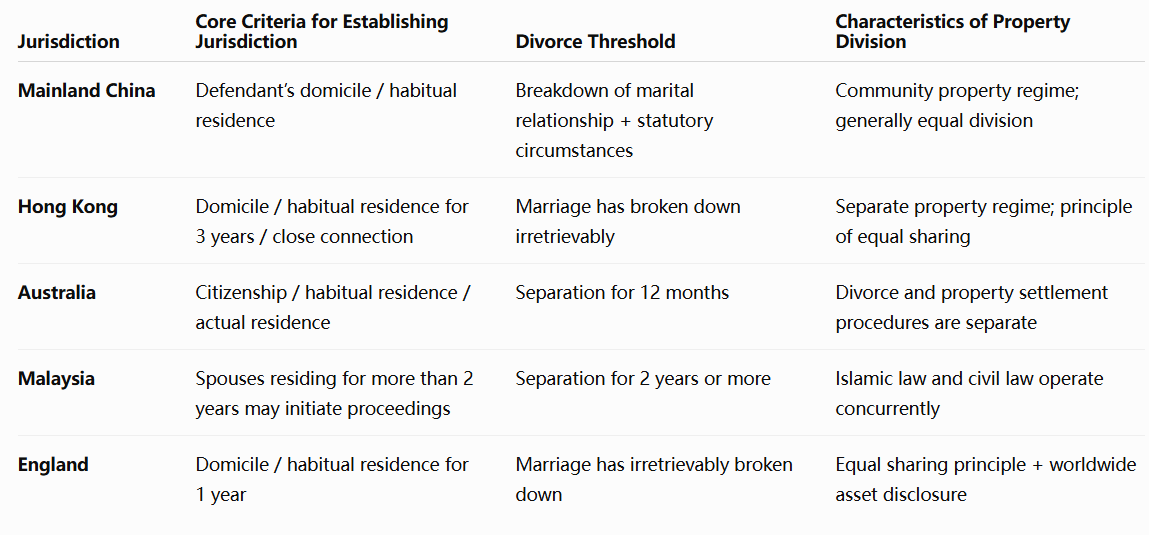
The comparison shows that Mainland China relies on the defendant’s habitual residence as the primary connecting factor, making the jurisdictional rules relatively rigid and predictable.Hong Kong, however, adopts a three-tier jurisdictional framework, with the “substantial connection” criterion providing a flexible gateway for jurisdiction.In practice, parties in Hong Kong divorce proceedings can often satisfy the jurisdictional requirements more easily, while parties in Mainland China who only focus on Mainland jurisdictional rules may underestimate the feasibility of initiating proceedings in Hong Kong.
Overview of Jurisdictional Characteristics Across Multiple Jurisdictions
Cross-border family law cases involve jurisdictions far beyond mainland China and Hong Kong. The following is a quick overview of the jurisdictional characteristics of several common jurisdictions:
Australia: Separation of Divorce and Property Proceedings
A marriage can be dissolved after 12 months of separation, while the division of property follows a separate, independent process. This means that in Australia, “finalizing the divorce” and “finalizing the property division” may be two distinct matters, requiring separate planning in terms of timelines and strategies.
England: Global Assets Order—A Powerful Tool in Cross-Border Cases
Based on the principle of equal sharing established in White v White [2000] UKHL 54⁷, English courts typically use a 50/50 split as the starting point and may issue orders covering global assets—regardless of the country in which the assets are located, the court has the authority to include them in the division. Even if your real estate is in Singapore or your equity interests are in the Cayman Islands, English courts can include them in the division—whether they can actually be enforced is another matter, but the judgment itself will account for all these assets. More notably, even if the divorce is finalized abroad, the parties may still apply for post-divorce financial relief in England under Part III of the Matrimonial & Family Proceedings Act 1984⁸—essentially serving as a “second chance.”
Malaysia: Special Convenience for Wives Filing for Divorce
Under relevant Malaysian matrimonial laws⁹, a wife who has resided in Malaysia for at least two years may file for divorce on her own, without requiring her husband to be present in Malaysia for the case to proceed. For Chinese nationals married to Malaysians, this represents a jurisdictional connecting factor that can be actively utilized.
- The Core Meaning of a Comprehensive Jurisdictional Analysis
The key point of a comprehensive analysis is: do not focus on only one jurisdiction. A party’s nationality, habitual residence, location of assets, and habitual residence of children may each create a potential jurisdictional connection.In cross-border family law cases, the question is not simply whether there is jurisdiction, but rather which jurisdictions are available and which one is the most advantageous.
Step 2
Coordinating Primary and Secondary Strategies
Once the comprehensive assessment is complete and you know which jurisdictions are available, the next questions to answer are: Where should you litigate, and how?
The most common misconception is that mainland lawyers handle cases in mainland China while overseas lawyers handle cases abroad, each operating independently. This “two-front strategy” may seem comprehensive, but it is actually risky—without a unified strategy across both fronts, the two efforts are likely to undermine each other.
Determine the Primary Battleground First
The selection of the primary battleground depends on a comprehensive assessment of three factors: the distribution of assets, jurisdictional thresholds, and differences in substantive law. Taking cross-border cases between the Mainland and Hong Kong as an example, a key difference in substantive law is the property regime: the Mainland implements a statutory community property system, under which assets acquired during the marriage are, in principle, divided equally; Hong Kong operates under a separate property system, but the courts exercise discretion based on the principle of equal sharing (established by the Hong Kong Court of Final Appeal in LKW v. DD⁶), which may result in a more generous division. In practice, if the majority of assets are in Hong Kong, parties often prefer to choose Hong Kong jurisdiction; if the majority of assets are on the mainland, mainland courts have stronger enforcement power over local assets.
However, the main battleground is not simply a matter of “litigating where the assets are located.” Other factors must also be considered: Has the opposing party already filed a case in another jurisdiction? Where is the children’s habitual residence? Which jurisdiction’s jurisdictional thresholds are easier to meet? These variables intertwine, requiring lawyers to make a comprehensive assessment rather than focusing on any single factor.
- Mainland-Oriented Strategy
This approach applies where the main assets are located in Mainland China, the children reside in Mainland China, and Mainland jurisdictional connections are clear.Mainland lawyers take the lead in litigation proceedings, while overseas lawyers assist with matters such as local asset preservation and evidence collection.
- Mainland-Dominated vs. Overseas-Dominated
- Overseas-Oriented Strategy
This approach applies where the main assets are located overseas, the other party has initiated proceedings overseas, or overseas substantive law is more favorable to one party.
The role of Mainland lawyers shifts from being the primary litigators to supporting counsel.
The focus is no longer on conducting an independent lawsuit in Mainland China, but on providing support for the overseas litigation strategy, including:
• Applying to Mainland courts for asset preservation measures;
• Freezing the other party’s assets located in Mainland China;
• Applying for investigation orders and obtaining evidence such as the other party’s bank transaction records and real estate information in Mainland China;
• Cooperating with disclosure requirements of overseas courts;
• Collecting evidence within Mainland China.
Real-World Case Study: Not Giving Up Domestic Jurisdiction Too Easily
- Case Example
Ms. Su (from Xiamen) married Mr. Li, an Australian citizen, in Indonesia in 2016. When they divorced in 2024, Mr. Li claimed that “the marriage took place in Australia, and Chinese courts had no jurisdiction.”
At the same time, he concealed approximately RMB 12 million worth of real estate in Indonesia and company equity interests.
The lawyer’s breakthrough point was not to file a lawsuit in Australia, but to accurately apply China’s foreign-related jurisdiction rules.
By using evidence such as Ms. Su’s five consecutive years of social security records in Xiamen, the lawyer proved that the Xiamen court had jurisdiction.
When the opposing party claims overseas jurisdiction, do not easily abandon the possibility of Mainland jurisdiction.
First establish your own strategic position, then determine the optimal litigation arrangement.
Three Key Points for Collaboration Between Lawyers in Two Jurisdictions
Unified Strategy
Lawyers in both jurisdictions must reach an agreement before litigation begins regarding where the primary battleground and secondary battleground will be, and how their respective timelines will be coordinated. The worst scenario is for a mainland lawyer to have already filed a motion to challenge jurisdiction with the court, while a foreign lawyer takes actions in another jurisdiction that contradict the position taken in that motion.
Distinguish Between Primary and Secondary Fronts
The primary front advances the core claims, while the secondary front provides support—such as asset preservation, evidence discovery, and procedural measures. The secondary front is not a second primary front and must not overshadow the primary one.
Synchronized Timing
Mismatched litigation timelines across the two jurisdictions are the most common stumbling block in cross-border cases. For example, mainland litigation may have already entered the substantive hearing phase while the overseas proceedings are still at the jurisdictional objection stage; or conversely, a temporary order may have been issued overseas while the mainland case has not yet been filed. Such timing discrepancies can lead to strategic disjointedness and even allow the opposing party to exploit the time gap to defeat the case piece by piece.
The Essence of a Lead Counsel Strategy
The essence of a lead counsel strategy is to treat a cross-border case as one integrated battle, rather than two separate lawsuits fought independently in different jurisdictions.
Step 3
The Red Line of Procedural Abuse
The first two steps address the question of “how to secure favorable jurisdiction”—identifying the optimal jurisdiction and establishing a strategic framework. However, there is one red line that must not be crossed in the pursuit of jurisdiction: if you go too far, the court may deem it an abuse of process. Not only will you fail to secure jurisdiction, but it may also result in the courts in one or both jurisdictions refusing to hear the case, leaving the client’s interests completely unprotected.
The Pitfall of Mutual Recognition and Enforcement in Parallel Proceedings
The most common risk scenario in cross-border family law cases involves filing lawsuits simultaneously in two jurisdictions—parallel proceedings.
This does not mean parallel litigation is impossible. In the case of Lan v. Hao¹¹, Lan (a Chinese national) and Hao (an Australian national) married in Australia in 2004. In 2017, both parties filed for divorce separately in Australia and China, seeking the division of real estate in their respective jurisdictions. Judge Rees ruled that the Chinese and Australian proceedings could proceed simultaneously, reasoning that Chinese courts lack jurisdiction to divide Australian real estate, and that Australian court judgments regarding Chinese property would not be recognized or enforced by Chinese courts—the two sets of proceedings dealt with different assets and thus did not conflict with one another.
However, the Lan v. Hao case was viable precisely because the Chinese and Australian proceedings dealt with different assets and did not conflict. If the parties were disputing the same asset, the risks associated with parallel litigation would be entirely different.
Restrictions on Recognition and Enforcement in Relation to Parallel Proceedings under the Arrangement on Reciprocal Recognition and Enforcement of Judgments in Civil and Commercial Matters
Article 9(3):
Where the requested court has accepted related proceedings, and the requesting court subsequently accepts proceedings concerning the same dispute and renders a judgment, such judgment shall not be recognized or enforced.
Article 9(4):
Where the requested court has already rendered a judgment concerning the same dispute, or has already recognized or enforced a judgment rendered by a court of another country or region concerning the same dispute, the subsequent judgment shall not be recognized or enforced.
What does this mean? If a court in Location B accepts the case first, and a court in Location A subsequently accepts the case and issues a judgment, that judgment will be refused when applied for recognition and enforcement in Location B. Even if you win the case in the jurisdiction where you filed second, the judgment may not be recognized when you seek to enforce it in the jurisdiction where you filed first—effectively rendering the effort futile.
Hong Kong’s regulations are even more specific. The Mainland Judgments in Matrimonial and Family Matters (Mutual Recognition and Enforcement) Ordinance (Chapter 639¹³) lists parallel proceedings as a statutory ground for setting aside the registration of a judgment: if, prior to the Mainland court accepting the case, legal proceedings had already been initiated in Hong Kong involving the same parties and the same cause of action, the registration of that judgment may be set aside.
Parallel proceedings are not a matter of “whether you can litigate in both jurisdictions,” but rather a matter of carefully weighing the consequences: whether the judgments rendered by both courts can ultimately be recognized and enforced in the jurisdiction where enforcement is needed.
If the judgment rendered by the later-seised court is not recognized, the resources and costs invested in the parallel proceedings may ultimately be wasted entirely.
Strategies for the Party Filing the Later Lawsuit
If the opposing party has already filed a lawsuit in another jurisdiction, as the party filing the later lawsuit, you should pursue a two-pronged approach:
- The First Line of Strategy: Challenging the Jurisdiction of the Court Where the Opposing Party Has Initiated Proceedings
The argument is that the court lacks a sufficient connection with the dispute and therefore is not an appropriate forum to exercise jurisdiction.
The standards for jurisdictional challenges vary across jurisdictions:
• Australia adopts a relatively high threshold for jurisdictional challenges, requiring the party to prove that the court is a “clearly inappropriate forum.”
• England and Malaysia apply the “forum non conveniens” doctrine, under which courts have broader discretion in determining whether another forum is more appropriate.
• Hong Kong applies the “appropriate forum” principle, under which the court conducts a comprehensive assessment of which jurisdiction has the closest connection with the disputeand is the most suitable forum for trial.
- The Second Line of Strategy: Assess Whether the Court of One’s Own Choice Is Also Appropriate to Exercise Jurisdiction
If the court of one’s own jurisdiction has a valid basis to hear the case and its substantive law is more favorable to the party, initiating proceedings there may be considered. However, the risks associated with recognition and enforcement of judgments must be carefully assessed.
A judgment rendered by one’s own court may not be recognized or enforced in the jurisdiction where the opposing party has already initiated proceedings.
If the main assets are located within one’s own jurisdiction and the judgment does not need to be enforced across borders, the risks of parallel proceedings may remain manageable. However, if the core assets are located in the opposing party’s jurisdiction and the judgment cannot be enforced there, then even a successful outcome may not lead to actual recovery of assets.
In other words, winning the case does not necessarily mean obtaining the money. At the very least, the judgment cannot be relied upon for enforcement in the opposing party’s jurisdiction, and separate proceedings may still need to be initiated in that jurisdiction.
Both tracks can proceed simultaneously—challenging jurisdiction in the opposing court while preparing to file a case in one’s own court. Arguing before the opposing court that “it lacks jurisdiction” and arguing before one’s own court that “it is the more appropriate forum” are logically complementary—the opposing court lacks jurisdiction precisely because there is a jurisdiction with a closer connection and better suited to hear the case.
The Boundaries of Procedural Abuse
Beyond parallel litigation, there is another boundary in jurisdictional strategy that requires particular attention: whether the court will question the motivation behind choosing a particular jurisdiction for filing a lawsuit.
In cross-border family law cases, parties naturally choose to file in a particular jurisdiction because its legal rules are favorable to them—which is legally legitimate. However, the core of the court’s review is whether there is a genuine connection between the case and that jurisdiction: Where do the parties reside? Where is the property located? Where are the children? If none of these connections exist, the rationale for choosing that jurisdiction will likely not withstand scrutiny.
For example, suppose one party files a lawsuit in Australia, but the primary assets and the focus of the dispute are not located in Australia. However, the mandatory disclosure rules under Australian family law may require the other party to fully disclose information regarding their global assets—information that might not be obtainable in a lawsuit filed in their home country. If the court determines that the primary motivation for choosing to file in Australia was to obtain disclosure of this information rather than to resolve the dispute, it may decline jurisdiction on the grounds of abuse of process.
The bottom line of a jurisdictional strategy is this: there may be strategic considerations, but the rationale for choosing a particular jurisdiction must withstand judicial scrutiny.
The key question is whether you choose that jurisdiction because the case has a genuine connection with that forum, or merely because the procedural rules of that jurisdiction are more favorable to you.
If the court determines that the latter is the true reason, you may not only fail to obtain jurisdiction, but it may also affect the court’s assessment of the party’s good faith and credibility, potentially creating adverse consequences for the substantive proceedings.
Conclusion
Jurisdiction isn’t won through litigation—it’s secured through strategic planning.
Looking back at the Dončić case, public attention focused on “whether child support should be paid,” but legal professionals know that the real battleground was “where the case would be heard.” The 12-fold difference in child support amounts between California and Slovenia wasn’t the result of a substantive dispute, but rather the result of a strategic choice of jurisdiction.
The strategy for establishing jurisdiction in cross-border family law cases can be summarized in three steps:
Step 1: Comprehensive Jurisdiction Assessment—Do not merely examine whether a case can be filed locally; simultaneously determine which foreign jurisdiction the opposing party might act upon first, and compare all potential jurisdictions. Differences in jurisdictional thresholds between mainland China and Hong Kong, as well as the characteristics of substantive law across multiple jurisdictions, are critical factors that must be mastered during this comprehensive assessment.
Step 2: Combining Primary and Secondary Strategies—Identify the primary and secondary battlefields. Lawyers in the Mainland and overseas must coordinate closely, unifying their strategies, clearly distinguishing between primary and secondary fronts, and maintaining a synchronized pace. A cross-border case is a single campaign, not two separate battles fought independently.
Step 3: Red Lines for Abuse of Process—In parallel litigation, carefully weigh the implications of mutual recognition and enforcement. The party filing the later lawsuit must simultaneously challenge jurisdiction in the opposing party’s court and prepare its case in its own court; the rationale for selecting the jurisdiction must withstand judicial scrutiny.
The core logic of the three-step approach is progressive: first gain a comprehensive understanding of the overall situation, then deploy strategic arrangements, and finally safeguard the bottom line. In cross-border family law cases, jurisdiction is not something to be fought for — it is something to be strategically planned.
参考文献
¹ 东契奇跨国抚养权管辖权争议,综合报道:ESPN、People、Daily Mail等媒体公开报道(2026年3-5月)
² 深圳市龙华区人民法院《深圳涉外涉港澳台家事审判中心白皮书》(2025年7月8日发布,统计区间2022年7月-2025年7月)
³ 《中华人民共和国民事诉讼法》(2023年修正)第22条、第23条
⁴ 香港法例第179章《婚姻诉讼条例》(Matrimonial Causes Ordinance)第3条
⁵ ZC v CN [2014] 5 HKLRD 43,香港高等法院上诉庭
⁶ LKW v DD [2010] HKC 1 / [2010] 13 HKCFAR 537,香港终审法院(确立香港平等分享原则) ⁷ White v White [2000] UKHL 54,英国上议院(确立英格兰平等分享原则)
⁸ Matrimonial and Family Proceedings Act 1984, Part III(英国)
⁹ 马来西亚婚姻家事相关法律
¹⁰ 苏女士与李先生中澳跨境离婚案,泽良律所代理,公开报道
¹¹ 兰某诉郝某中澳平行诉讼案,澳大利亚联邦巡回家事法院
¹² 最高人民法院《关于内地与香港特别行政区法院相互认可和执行婚姻家庭民事案件判决的安排》(法释〔2022〕4号)
¹³ 《内地婚姻家庭案件判决(相互承认及强制执行)条例》(香港法例第639章)