


Introduction
Does the fact that a will excluding statutory heirs has taken effect mean that the testamentary heir can rest easy and assert their right to inherit under the will at any time? In judicial practice, disputes over testamentary inheritance are not automatically classified as property rights disputes that are exempt from the statute of limitations; in some cases, parties lose their right to prevail in court due to the expiration of the statute of limitations. This article examines the question of “Does the statute of limitations apply to disputes over testamentary succession?” by analyzing relevant legal provisions and judicial practice, with the aim of providing guidance and reference for parties seeking to protect their legitimate inheritance rights.
I. Statistical Data
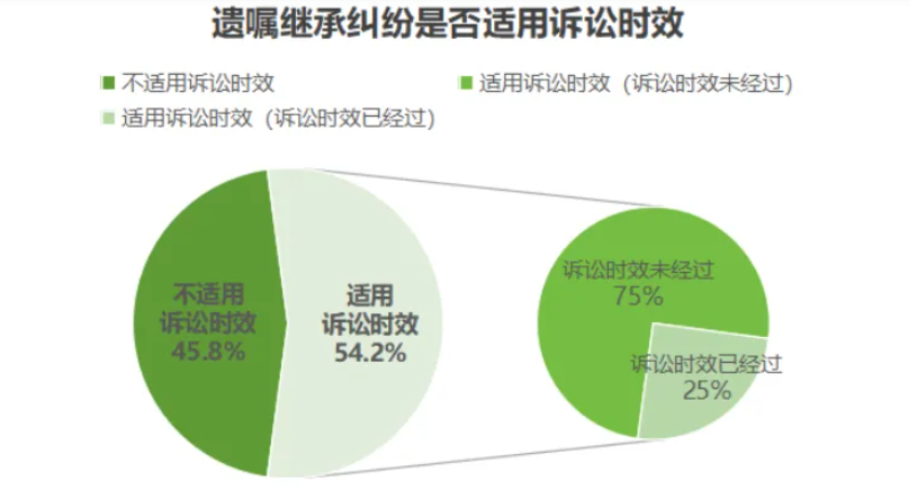
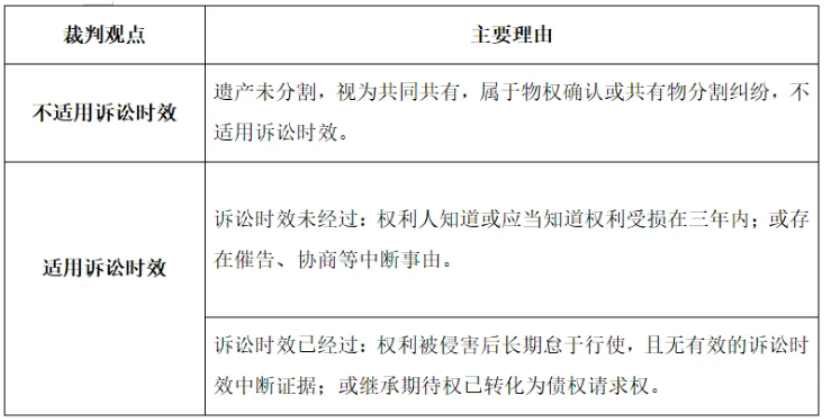
In disputes over testamentary succession, judicial practice exhibits a distinct “polarization” regarding the applicability of the statute of limitations. This article conducted a search on the China Judgments Online database using the keywords “inheritance disputes, wills, statute of limitations, and duration,” with a date range from January 1, 2021, to April 6, 2026, yielding a total of 59 valid judicial documents. Among these, 32 cases (54.20%) supported the application of the statute of limitations, while 27 cases (45.80%) did not. Among the 32 cases supporting the application of the statute of limitations, 24 held that the statute of limitations had not expired because the rights holder asserted their rights within the limitation period or due to grounds such as an interruption of the statute of limitations. In the remaining 8 cases, the court held that the statute of limitations had expired because the rights holder had been negligent in exercising their rights, had failed to take effective measures to interrupt the statute of limitations, or because the expectation right to inheritance had been converted into a claim for a debt.
II. Legal Basis for the Statute of Limitations on Disputes Regarding Testamentary Succession
The rules governing the statute of limitations for inheritance disputes in China have primarily evolved from the *Inheritance Law of the People’s Republic of China* to the *Civil Code of the People’s Republic of China*. Combined with the spirit of the judicial policies of the Supreme People’s Court, these provisions form the unified basis for court rulings.
(I) Key Legal Provisions
1. Article 8 of the former Law of the People’s Republic of China on Inheritance
“The statute of limitations for bringing an action regarding a dispute over the right of inheritance is two years, calculated from the date the heir knew or should have known that their rights were infringed. However, no action may be brought if more than twenty years have elapsed since the commencement of the inheritance.”
2. Article 188 of the Civil Code
“The statute of limitations for bringing an action before a people’s court to seek protection of civil rights is three years. Where the law provides otherwise, such provisions shall apply. The statute of limitations shall be calculated from the date on which the rights holder knew or should have known that their rights had been infringed and the identity of the obligor. Where the law provides otherwise, such provisions shall apply. However, if twenty years have elapsed since the rights were infringed, the people’s court shall not grant protection; where there are special circumstances, the people’s court may, upon application by the rights holder, decide to extend the period.”
3. Article 25 of the Notice of the Supreme People’s Court on Issuing the “Minutes of the Eighth National Conference on Civil and Commercial Trial Work (Civil Part)” (Fa [2016] No. 399)
“Where an estate remains undivided after the decedent’s death and none of the heirs has renounced their inheritance, pursuant to Article 25 of the Inheritance Law, all heirs shall be deemed to have accepted the inheritance, and the estate shall be held in joint ownership by the heirs; in cases where a party sues to assert inheritance rights or claims for the division of the estate, the principles governing the division of jointly owned property shall apply, and the provisions regarding the statute of limitations shall not apply.”
(II) Rules for Distinguishing the Nature of Rights
Based on the aforementioned legal provisions, when courts determine whether the statute of limitations applies to disputes over testamentary succession, they are essentially assessing the nature of the rights asserted by the parties; the rules applicable to different bases of claim differ significantly:
1. Claims Regarding Property Rights
When, following the death of the decedent, none of the heirs has renounced their inheritance and the estate has not been divided, the estate remains in a state of joint ownership for an extended period. In such cases, if any heir files a lawsuit seeking the division of real property, this constitutes a claim for the confirmation of title and division at the level of property rights. In accordance with the spirit of the relevant judicial guidelines issued by the Supreme People’s Court, the statute of limitations does not apply.
In practice, there are many cases where one parent dies first (leaving no will and with the estate undivided), followed by the death of the other parent (who leaves a will designating property to specific heirs). The core approach to handling such cases is as follows: first, the share of the predeceased spouse is separated from the marital property and distributed among the heirs according to statutory inheritance; then, the personal property of the surviving spouse (including property inherited by them) is handled according to testamentary succession; The entire estate remains in a state of joint ownership among all heirs prior to division; subsequent litigation effectively constitutes the division of jointly owned property, and based on property rights claims, the statute of limitations does not apply.
2. Claims for the Performance of Obligations
Where the will provides for monetary payments or compensation, the estate has been disposed of and converted into a claim, or the heirs have explicitly reached an agreement regarding the estate that constitutes a claim, and the right holder sues to enforce the obligation to perform, such claims fall under the category of claims for the performance of obligations and are strictly subject to a three-year statute of limitations.
3. Claims for the Right of Inheritance
There are differing views on the nature of the right of inheritance. The first view holds that the right of inheritance is a property right; the second view holds that the right of inheritance is a creditor’s right; the third view holds that the right of inheritance is neither a property right nor a creditor’s right, but rather an independent civil right. In China, the mainstream view endorses the third view mentioned above, namely, that the right of inheritance is an independent civil right on par with property rights and creditor’s rights. i
A claim for the right of inheritance is a right to seek confirmation of the validity of a will and the status of an heir. Its core lies in resolving the question of whether an heir has the right and qualification to inherit the decedent’s estate. After the commencement of inheritance and before the division of the estate, the status of each heir’s rights to the estate is not yet fully determined and must be clarified by exercising the right to claim restoration of inheritance. It is generally accepted in legal theory that this right possesses the attributes of a claim in personam; therefore, the provisions on the statute of limitations should apply.
III. Judicial Application of the Statute of Limitations for Testamentary Inheritance and Key Adjudication Rules
As mentioned above, if testamentary succession deprives other statutory heirs of their eligibility to inherit, or if—even without such deprivation—the distribution of the estate does not conform to the statutory shares of inheritance, this inevitably involves matters such as the determination of the will’s validity and the division of the estate. Drawing on judicial practice, the author will now analyze the judicial application standards, rules for calculating the commencement of the statute of limitations, and the burden of proof regarding its interruption in testamentary succession cases, based on typical judicial rulings.
(1) Rule 1: If a right to inheritance is infringed upon and there are no valid grounds for interruption of the statute of limitations, the right to prevail in court is lost upon expiration of the limitation period.
If a testamentary heir is fully aware of the contents of the will and knows that their rights have been infringed, yet fails to assert their rights in a verifiable manner for an extended period, the court will still deem the statute of limitations to have expired, even if the will is legally valid.
Representative Case: Jingzhou Intermediate People’s Court of Hubei Province (2021) E 10 Min Zhong No. 1 (Gong Mou 1 et al. v. Gong Mou 6 Testamentary Inheritance Dispute Case)
Basic Facts: The decedent, Gong No. 9, passed away in 2006. During his lifetime, he executed a valid and legal will designating the property in question to be inherited by the five plaintiffs: Gong No. 1, Gong No. 2, Gong No. 3, Gong No. 4, and Gong No. 5. In March 2011, the five plaintiffs—Gong Mou 1 et al.—learned of the contents of the will and became aware that the property was in the possession of the defendant, Gong Mou 6. In September 2011, the parties entered into a conditional performance agreement (“If Gong Mou 6 loses the lawsuit seeking division of other properties, the will shall be executed”). In April 2014, the defendant’s related lawsuit was dismissed by a final and binding judgment, and the conditions of the agreement were fulfilled; however, the defendant continued to refuse to surrender the estate and the demolition compensation. It was not until September 2018 that the five plaintiffs, including Plaintiff Gong No. 1, filed a lawsuit with the court, seeking a declaration that the will was valid and that the corresponding share of the housing demolition compensation was jointly owned by the five plaintiffs.
The court’s final judgment clearly states:
1. Basis for applying the statute of limitations: The plaintiff is not seeking the division of jointly held estate assets, but rather is asserting a claim for the enforcement of the will and a share of compensation based on an infringement of inheritance rights. This constitutes a dispute over inheritance rights and is subject to the statute of limitations; the rule that the division of jointly held property is not subject to the statute of limitations does not apply.
2. Determination of the starting point of the statute of limitations: The conditions attached to the agreement were fulfilled in April 2014. As the defendant refused to perform its obligations, the plaintiffs should have been aware at that time that their rights had been infringed; therefore, the statute of limitations began to run on April 30, 2014.
3. Rules of Evidence Regarding Interruption of the Statute of Limitations: The plaintiffs—Gong Mou 1 and four others—alleged grounds for interruption, such as asserting their rights against the defendant every Qingming Festival and the village committee’s involvement in mediation. However, their claims were based solely on oral statements regarding the assertion of rights, without supporting evidence such as written documents, audio recordings, or mediation records; consequently, the court did not accept these claims due to insufficient evidence.
This case clarifies that the statute of limitations does not automatically apply to testamentary succession; rather, its applicability must be determined based on the nature of the claim. Furthermore, the starting point of the statute of limitations is not solely based on the date of the decedent’s death or the date the will became known; it must be analyzed in light of the specific circumstances of each case. In this case, the starting point was determined to be the “fulfillment of conditions and the obligor’s clear breach of contract.”
(2) Rule 2: Where the content of a will consists of an obligation to pay money, it constitutes a claim for a debt, and the three-year statute of limitations applies strictly.
If a will does not directly allocate ownership shares of the estate but explicitly stipulates that a specific party shall pay monetary compensation or the value of the shares to the heirs, then such right constitutes a claim for a debt from the outset. The three-year statute of limitations applies in accordance with the law; if the heirs file their claim after the expiration of this period and fail to provide evidence of an interruption of the statute of limitations, their claim will not be protected.
Representative Case: Zhang County People’s Court of Gansu Province (2023) No. 1125 Min Chu 584 (Will Inheritance Dispute Case involving Lei Ting, Li Yuzhen, et al.)
Basic Facts: The decedent passed away in 2016. During his lifetime, he executed a notarized will requiring his son, Lei Dongdong, to pay his grandson, Lei Ting, 20,000 yuan in compensation for a plot of land. Lei Dongdong passed away in February 2017. The plaintiff, Lei Ting, did not file a lawsuit with the court until April 2023, demanding that Lei Dongdong’s heirs (his wife and son) pay the 20,000 yuan. The plaintiff claimed to have asserted his rights against the defendants via WeChat in 2019 but was unable to provide evidence due to having changed his mobile phone.
In this case, the content of the will constitutes a typical monetary claim. The statute of limitations begins to run from the date of the decedent’s death; upon the death of the obligor, the statute of limitations is interrupted and recalculated. Since the plaintiff did not file the lawsuit until 2023—well beyond the three-year period—and was unable to prove that he had previously asserted his rights, the court ultimately dismissed his claim.
(3) Rule Three: The maximum twenty-year period for the protection of rights serves as an absolute limit; beyond this period, the validity of a will will no longer be reviewed.
Inheritance begins upon the death of the decedent, and the maximum twenty-year protection period is calculated directly from the date of commencement of inheritance; the rules regarding suspension and interruption do not apply. Regardless of whether the heir was aware of the will or of the infringement of their rights, if this period has expired and there are no statutory grounds for extension, the court will no longer review the validity of the will, nor will it administer the estate in accordance with its terms.
Representative Case: Shanghai Jing’an District People’s Court (2022) Hu 0106 Min Chu No. 5057 (Dispute over the Division of Family Property between Shen Mou 1 and Shen Mou 9 et al.)
Basic Facts: The decedent, Shen Mou 10, and Li Mou were formerly married and had seven children together. Shen Mou 10 passed away in February 2001. Prior to his death, he executed a holographic will bequeathing the real estate to six of his children (excluding Shen Mou 1). In 2022, Shen Mou 1 filed a lawsuit seeking the division of the real estate in accordance with statutory inheritance. The defendant argued that the estate should be divided in accordance with the will and moved to dismiss all of the plaintiff’s claims.
The final judgment held that, as the holder of the will and a beneficiary of the estate, the defendant should have actively asserted his rights within the statutory limitation period to ensure that, in the event of a dispute, the matter could be resolved through litigation to safeguard his inheritance rights. However, in this case, Defendant Fang Mou 1 initiated the lawsuit and raised the defense requesting that the property be distributed according to the will more than twenty years after the death of the decedent, which clearly exceeds the maximum statute of limitations prescribed by law for the protection of litigation rights. Therefore, this Court will not adjudicate on the validity or content of the will in this case, nor will it proceed with inheritance in accordance with the will… The plaintiff’s current claim for a one-seventh share of the property does not exceed the scope of his rights, and this Court hereby grants it. The remaining six-sevenths of the property shall be owned by Defendant Shen No. 3, in accordance with the agreement between the defendants.
IV. Practical Guidelines
1. The validity of a will is permanent; however, the exercise of inheritance rights is subject to statutes of limitations. A legally valid will does not lose its validity due to the passage of time; however, when an heir under a will asserts specific rights—such as claiming a larger share of the estate, the delivery of the estate, or the payment of compensation—they must comply with the rules on statutes of limitations. Merely holding a will does not mean one may neglect to exercise their rights.
2. The nature of the claim determines the applicable statute of limitations. Claims regarding property rights, such as claims for confirmation of title or partition of jointly owned property, are generally not subject to the statute of limitations; claims for monetary payments or periodic income specified in a will are subject to a three-year statute of limitations, which begins to run from the date the claimant knew or should have known of the infringement of their rights and the identity of the obligor. To assert an interruption of the statute of limitations, valid evidence must be provided.
3. The maximum protection period of twenty years cannot be exceeded; inheritance matters should be addressed promptly. This period begins on the date of the decedent’s death; if the deadline is missed, the rights will no longer be protected by law. Heirs under a will should promptly disclose the will and assert their inheritance claims after the decedent’s death. They should expedite matters such as the confirmation of title and transfer of real property, as well as the demand and assertion of claims for debts. Evidence of all communications, demands, and mediation efforts should be retained throughout the process. In the event of a dispute, professional assistance from a family law attorney should be sought promptly to avoid losing legitimate inheritance rights due to the expiration of the statute of limitations.
A will embodies the dignity of the deceased’s wishes, while the statute of limitations maintains the balance of the legal order. A legally valid will serves as the foundation of rights; only by exercising inheritance rights in a timely and appropriate manner can the deceased’s wishes be truly fulfilled. Timely resolution is paramount in family disputes, and testamentary succession is no exception. Possessing a will does not guarantee permanent peace of mind; only by proactively asserting your rights and properly preserving evidence can you prevent the will from becoming “a mere piece of paper” due to the expiration of the statute of limitations.
i *Understanding and Application of the Judicial Interpretation (I) of the Supreme People’s Court on the Inheritance Provisions of the Civil Code*; Author: First Civil Trial Division of the Supreme People’s Court; Page 058